Steel estimating services, and what happens when you ask an AI company to be one

tldr: Steel estimating services sell you hours of counting off a drawing set. By hand, the counting is the slow half of an estimate. With a model, it is the fast part, and the review is not. What you are really buying, from any of them, is somebody else's reading of your set, and this piece walks what that reading involves, which half of it we will run with you when you ask, and how to check whoever did it.
Steel estimating services are outside estimators, firms, or offshore teams that read your structural drawing set and return the member counts, tonnage, and sometimes a priced bid, for a fee per set or a monthly package. Steel is one trade inside the much larger market for metals estimating services, which is why the pages selling it read like they were written for a general contractor. The three-way choice between a service, a hire, and software, including what structural steel estimating services are and are not, is in outsource, hire, or buy software. What structural steel takeoff services charge is in the cost post.
A set lands Monday. The bid is due the Friday after next, your estimator is already carrying two others, and somebody in the meeting says send it out. So you do. Eight days later a spreadsheet comes back with tonnage on it and you have to decide whether to trust it. Nobody tells you how.
We build steel takeoff software, and most months a fabricator asks whether we will just do the estimating for them instead. This is the answer I give on the call, written down. It comes in two parts and one of them is no.
What a steel estimating service actually does with your set
Every service runs some version of the same seven steps. Freelancer, offshore team, or model, the work goes in this order.
| Step | What it needs from the set | Where it goes wrong |
|---|---|---|
| Sort the sheets | The full S-series and the specs, not the sheets somebody thought were relevant | Sets arrive with scans sitting next to vector sheets, or with the schedules left out, and the AESS, galvanizing, and bolt requirements sit in the specs nobody sent |
| Read the general notes | The general notes sheet, S-001 or S1.0 on most sets, and its UNO notes | A UNO on the notes sheet governs forty beams on sheet nine, and a counter working plan by plan never sees it |
| Build or reconcile the column schedule | A schedule, or the elevations and sections to build one from | A sizable share of sets have no usable schedule, or none in the set, and counting columns off the plan misses splices and the steel below the slab |
| Count the framing plans level by level, and the braces off the elevations | Callouts, marks, grid lines, camber and stud notes, the brace elevations | Duplicate counts across addenda, and members counted once on plan and again on elevation |
| Pull connections, plates, and studs from the details | Sections, typical details, the connection schedule | Tonnage-only services skip this, and it is where the shop hours live |
| Roll up to tonnage by category | Weight per foot off the shapes table | The arithmetic is fine. The categories are not your shop's categories |
| Price it, if the quote covers an estimate | Your shop's rates, your fab strengths, your margin | The service has none of the three unless you hand them over, and the number is still not yours |
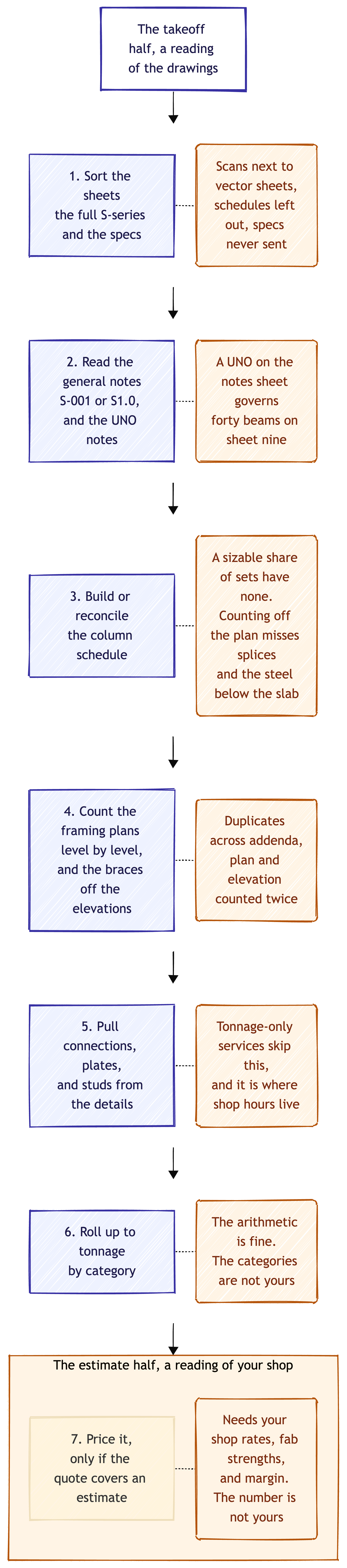
None of that is exotic. It is what a structural steel quantity takeoff contains, walked in order, and the order does not change whether the counter bills at the cheapest hourly rates on the market or the highest. The cost post has those rates. Step three is where most of the damage happens, because the column schedule is the takeoff for columns and the framing plan is only the check. Step four hides a quieter one: when a set has been revised, counting the new sheets without comparing them against the old set gets you the same beam twice. And shear studs ride the beam callout as a count in parentheses, so a takeoff that shows the beam and drops the parenthetical did not read the callout.
Look at the last row again. That one decides whether you bought a takeoff or an estimate, and most quotes do not say.
The takeoff half and the estimate half
Most firms selling steel take-off and estimating services sell both halves, price both halves, and leave the quote vague about which one you are getting. Ask. They are different deliverables produced at different moments for different reasons.
The takeoff half is a reading of the drawings. Anyone who can read structural drawings and knows steel can produce it, and a model can produce most of it. The estimate half is a reading of your shop. It runs on your hours per ton, which swing with connection type and with your crew and your equipment, plus your material pricing and the margin you carry on this GC. An outside firm can ask for those numbers and apply them, and the result still will not carry what your estimator knows about this job. The number will not be yours.
I have watched a model get the count right and the estimator change the bid anyway. By hand, the count is the slow half. It was never the hard half.
Who is doing the counting in 2026
Outsourced estimating services get the counting done three ways now, and a full-service firm may run any of them behind the same quote. It matters which one is holding your set.
A person in Bluebeam. US firms and one-estimator shops, clicking through your sheets. The counting takes the days a takeoff takes by hand, and turnaround at the steel-specific firms runs a few business days. The cost post has the sourced figures.
A team nine time zones away. Cheapest per set by a distance, and the revision goes into a queue you cannot see or push. Fabricators have told us they lost bids waiting on an outside team to turn a revision while the deadline held still, and the further away the team, the longer the set sits. That pattern is in the outsourcing piece.
AI detection with a human check. The model reads the set in minutes and a person reviews what it found. Two things moved this year. One multi-trade takeoff product now sells a done-for-you AI takeoff with a human QA pass, turnaround of 24 to 72 hours, alongside its self-serve workflow. And in March a large steel service center group bought a steel takeoff tool and now offers it as a value-added service of buying steel from its companies. When the counting comes bundled with the material, the counting is not what you were paying for.
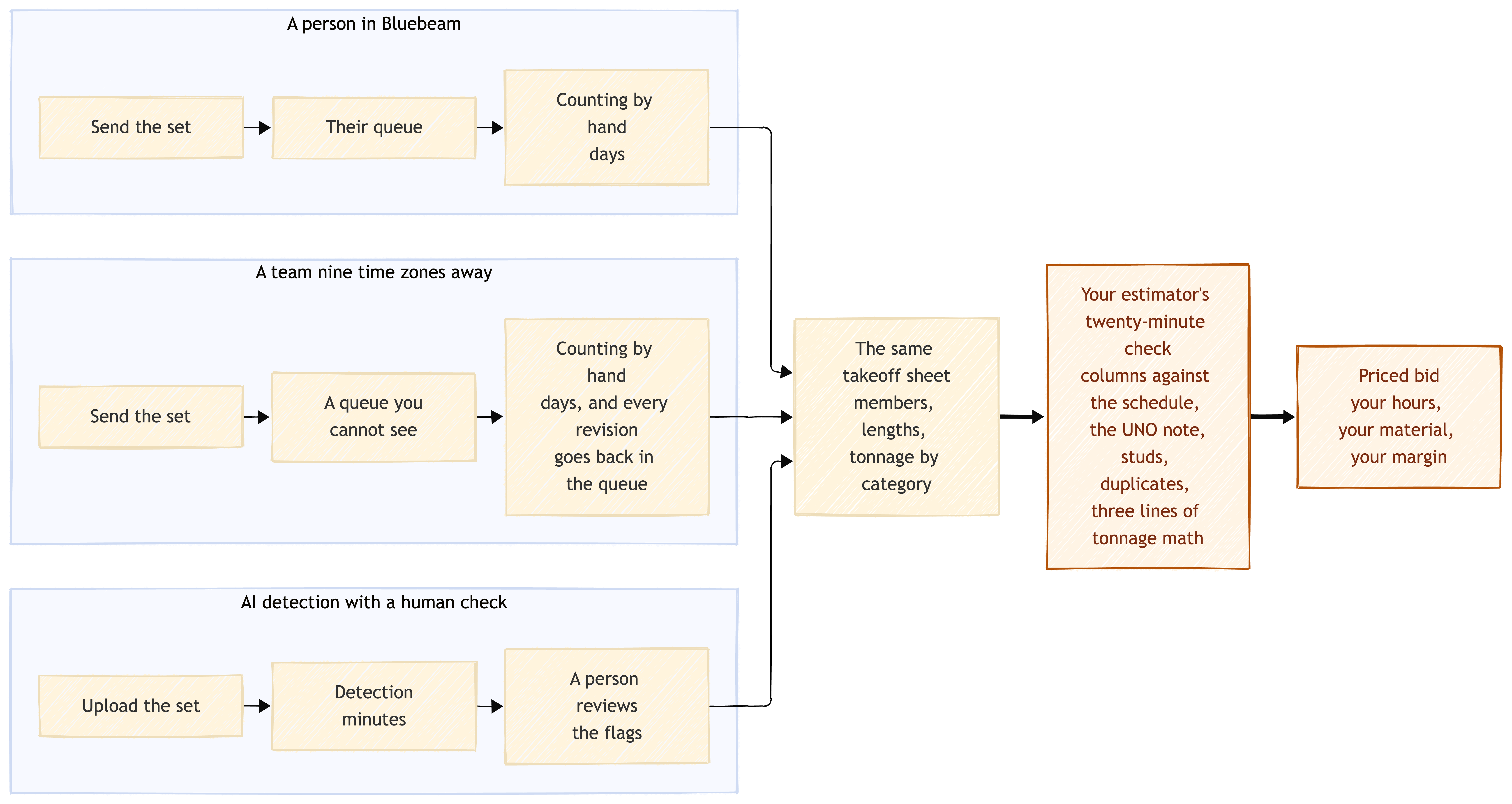
In all three the deliverable is the same table from the section above. The counting box shrank, and the review box did not move at all.
Yes, we will run your takeoff with you
Here is the yes.
You send the set you are actually bidding, with the ITB and the specs. Not a demo file. Scans next to vector sheets, a schedule or no schedule, a UNO note buried on a sheet you only open because you have been burned before. We run it in Ferra and walk it with your estimator, marking what came off the schedule and what came off the plan.
Bring the messiest set you bid recently and we will run it with your estimating team, then walk through what Ferra detected and what needed review. Book the walkthrough, or sign up free and run a set yourself first.
We run it with you, not for you, because the review is yours and the walkthrough is where the review happens.
What comes back is every detected member located on its own sheet, with the connection type and the reactions the drawings already carry and the stud count off the callout, the takeoff laid out by level and category, and flags on the places the model was not certain. A takeoff example shows the shape of it. Takeoffs that took days finish in under an hour. Then your estimator confirms every number, line by line. That is the review the last section said you were keeping either way.
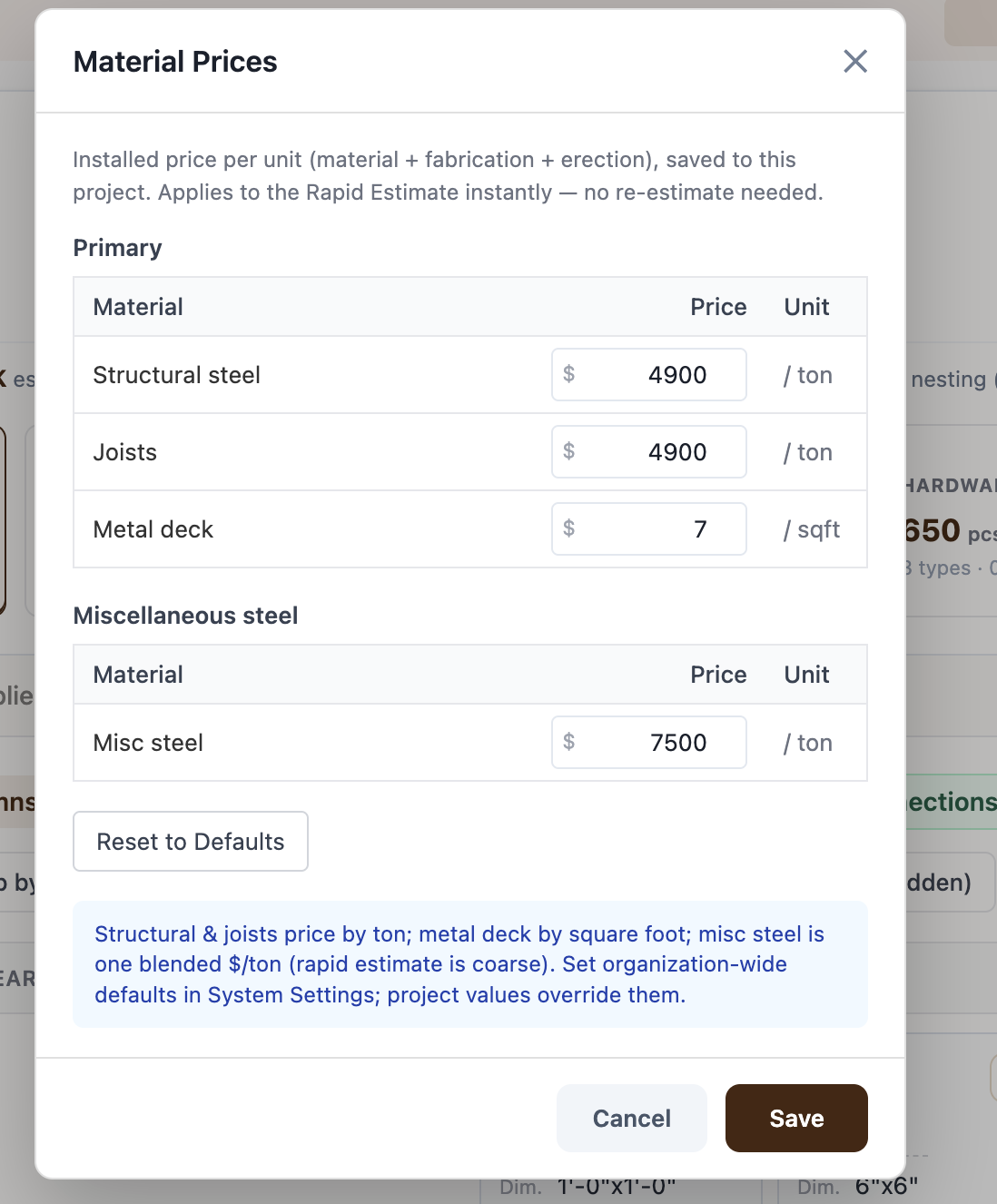
The pricing runs from your numbers, not ours. Open the settings on the takeoff, enter your labor rates, your material prices per ton by material, and the cost of the items you buy in, and the takeoff table carries shop hours, erection hours, labor, material, paint, and nesting estimates against the tonnage. Change a rate and the estimate moves with it.
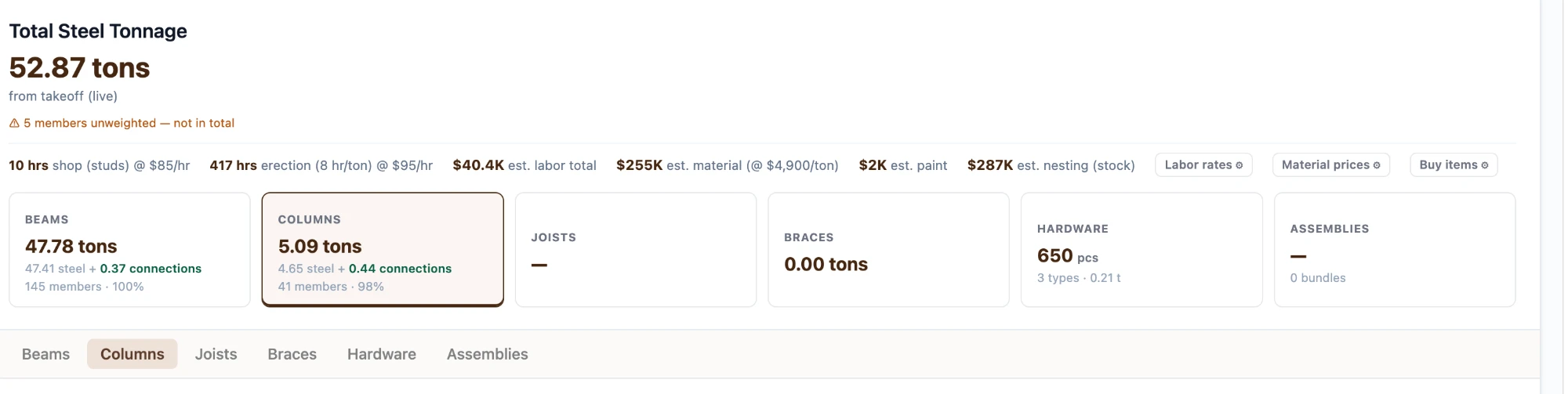
Four limits, because you will hit them. Scanned and hand-marked revisions are harder than vector sheets. A set with no column schedule means the takeoff starts by building one, and that is visible work you should check first. We do not design connections, on purpose. We record the type and the forces that are already on the drawings, and we do not engineer one the drawings do not show. And I will not quote you an accuracy percentage. Run a set you already know the answer to.
What we will not do
We will not invent your numbers. Ferra prices the takeoff from the labor rates, material prices, and item costs you enter, and the estimate on the table is exactly as good as those inputs. What we do not have, and will not guess at, is the margin you carry on this GC, what your crew actually burns on a moment connection, and which owner pays late. A service can ask you for your labor factors and apply them too, and the bid still will not carry what your estimator knows. The person who turns an accurate count into a competitive number works for you, sits in your office, and adjusts the rates we priced from.
We are not a detailing service. Shops search for steel estimating and detailing services as one phrase because both jobs start from the same drawings, but they are different deliverables at different moments. Estimating produces the count and the price before award. Detailing produces shop drawings, erection drawings, and piece marks after award, and that is Tekla Structures and SDS2 territory. We hand off by IFC and CSV rather than pretend to replace them. Which category owns which tool, and where estimating sits before all of it, is in the fabrication software map.
And we will not tell you the service is always the wrong call. A shop with nobody on staff to review a takeoff should buy the service until it hires the person, because unreviewed software output is a liability and an unreviewed spreadsheet is the same liability with an invoice attached. Four sets a year, pay per set and stop thinking about it. A scope you price twice a year, send it out to somebody who prices it weekly. The cost post writes out the cases where paying for a service is the right call.
How to check any steel takeoff in twenty minutes
Nobody sells you this part, and it decides whether the takeoff was worth paying for. The cost post's eight questions are for before you send the set. These eight are for after it comes back, whoever counted it. A structural steel estimator can run them on any takeoff, from any source, and each one is a sample, not an audit.
- Columns against the schedule, not the plan. Pick three column lines and trace each one from base plate to roof. The size should change at the tiers the schedule says, and the splice count should match.
- The steel below the slab. Column lengths should run from the top of footing or pier, not from the slab. On some details those two elevations are the same. On most they are not, and the stick between them is real steel.
- The UNO note. Find one on the general notes sheet, S-001 or S1.0 on most sets, pick two members it governs on another sheet, and confirm it reached them.
- Studs against the callout. The count rides the beam callout. If the plan says W18x35 (26) and the takeoff shows the beam with no stud count and no exclusion, the callout was not read.
- Connections as a line, not a note. Tonnage-only takeoffs skip the plates, the bolts, and the shop hours behind them. Ask where they went.
- Duplicates across addenda. If the set carried a revision, spot-check three changed beams and confirm each was counted once.
- Three lines of tonnage math. Quantity by length by weight per foot, divided by 2,000. How to calculate steel tonnage has the worked version.
- Deck and misc metals, present or explicitly excluded. Silence is the expensive answer, and miscellaneous metals is where silence costs the most.
A takeoff that passes all eight is one you can price. The checks are identical whether a person or a model produced the count, which is the clearest sign that the counting was never the part worth paying a premium for.
FAQs
What do steel estimating services include?
Sheet sorting, the general notes, the column schedule, level-by-level counts, connections and studs pulled from the details, and tonnage rolled up by category. A priced estimate is usually a separate deliverable at a separate price, so confirm which one the quote covers before you send the set.
Can an AI company do my steel estimating?
The takeoff, yes. AI detection reads the set and an estimator confirms every line. The pricing, from your numbers. Enter your labor rates, material prices, and item costs and Ferra puts shop hours, material, paint, and nesting against the tonnage. The margin, and the judgment about this job, stay with your estimator.
Do you offer a steel takeoff service?
Not as a service you hand off. We run your own set with your estimating team on a walkthrough, show what was detected and what needed review, and your estimator confirms every line. Shops can also sign up free and run a set themselves. Pricing the bid stays with the shop.
What is the difference between steel estimating services and steel detailing services?
Estimating produces the count and the price before award. Detailing produces shop drawings, erection drawings, and piece marks after award, usually in Tekla Structures or SDS2. Same drawings, different deliverable, different moment in the job. Firms often sell both, which is why the phrase travels as one.
Can AI price a structural steel bid?
From your rates, yes. A model counts the set, rolls up tonnage by category, and applies the labor rates and material prices you entered to get labor, material, and coatings estimates. What it cannot supply is the rates themselves or the margin you decide to carry on this job. A number produced from somebody else's rates is accurate to somebody else's shop.
How do I check an outsourced steel takeoff?
Run the eight checks above. Columns against the schedule rather than the plan, the steel below the slab, the UNO note, the stud count against the callout, connections as a line item, duplicates across addenda, three lines of tonnage math, and deck and misc metals either present or explicitly excluded.
Send us the set you are bidding this week. We will run it, then walk it with your estimator, who confirms every line of what Ferra found.
Send us the set, or sign up free and run it yourself first.