What a structural steel takeoff service costs, and when it is worth paying for
Published 2026 prices for a structural steel takeoff service run from around \(150 for a small set to \)2,500 and more for a large one, and a monthly package brings the per-set figure down. Divide the per-set price by your win rate before you compare anything. At a 12 percent win rate, a \(400 takeoff is about \)3,300 of takeoff spend per won job.
A structural steel takeoff service is an outside estimator, firm, or offshore team that reads your structural drawings and returns the member counts, lengths, and tonnage your bid is priced from, usually for a fee per set or a monthly package.
Every page that ranks for that phrase was written by a service, and none of them puts a price on the page. You upload a set to find out. So this is the price list, pulled from the handful of firms and benchmarks that do publish one, along with the costs that show up later on the invoice and never on the quote.
We build AI steel estimating software, which is one alternative to a service. Some shops reading this should hire the service anyway, and I would rather tell them so than sell them something nobody in their office will review.
What you get back from a takeoff service
You send the ITB package. What comes back is a takeoff sheet: marks, shapes, quantities, lengths, weight per foot, and tonnage by category, sometimes with deck and miscellaneous metals broken out. The anatomy of that sheet is in what a structural steel quantity takeoff contains, so I will not repeat it here.
Check first whether the quote covers a takeoff or a priced estimate. They are different deliverables and most services sell both at different prices. A takeoff is the counts. An estimate is the counts plus your material, your shop hours, and your margin, and an outside firm has to guess at the last two.
Who does the work varies more than the deliverable does. Some services are US-based estimating firms with a bench across trades. Some are one experienced estimator with a Bluebeam license and a backlog. The cheapest per set are offshore teams working a long way from your time zone, and that gap matters more than the price does, for reasons that come up below. Steel is also a small trade inside the much larger market for material takeoff services and quantity takeoff services, which is worth remembering when you read the benchmarks, because most of them were built for the whole market.
What structural steel takeoff services cost in 2026
Here is what the firms and benchmarks that publish numbers say. Every row names its source, and the sources are listed in full at the end. Nobody in this table is a recommendation.
| Pricing model | Published range | What it usually covers | Source |
|---|---|---|---|
| Per set, small job | \(150 to \)400 | a few sheets, one trade | Veracity, steel pricing page; Takeoff Monkey, Jan 2026 |
| Per set, mid-size commercial | \(400 to \)900 | 25 to 75 pages, multi-trade commercial | Takeoff Monkey, Jan 2026 |
| Per set, large or complex | \(900 to \)2,500 and up | multi-story, multi-division set | Takeoff Monkey; Quotr, Aug 2026, upper end $5,000 and more |
| Steel-specific flat fee | around $200 typical | a steel and metals estimate, scope-dependent | World Estimating |
| Monthly package | from $1,000 per month | 5 to 6 small or medium jobs, or 3 to 5 medium or large | Veracity, steel pricing page |
| Retainer discount | 20 to 40 percent off per-set pricing | committed monthly volume | Takeoff Monkey, Jan 2026 |
| Rush, 24 to 48 hours | plus 20 to 50 percent | expedited turnaround | Quotr, Aug 2026 |
| Per square foot | \(0.25 per sq ft under 50,000 sq ft, \)0.10 above | Quotr's own building-estimate model, not a steel takeoff fee | Quotr |
| Hourly | advertised at $12 per hour | per-hour billing in Bluebeam or PlanSwift | Advance Estimating |
Most of those benchmarks cover construction takeoffs in general. The steel-specific pricing that is public amounts to two firms and a "starting from" figure, so treat the ranges as the shape of the market and your own quote as the fact.
Standard turnaround at the steel-specific firms is two to four business days. Some advertise 24 to 48 hours, and the rush row is what that costs when it is not the default. Notice, too, that the lowest rate in the table is $12 an hour. At that price the economics point to a lower-cost labor model, and the page does not say where the estimating work is performed, so ask. That question is where the next section starts.
The costs that never make the price sheet
The per-set price is the smallest number in the transaction, which is why it is the one on the page. The rest of the bill arrives later, in three forms.
The revision
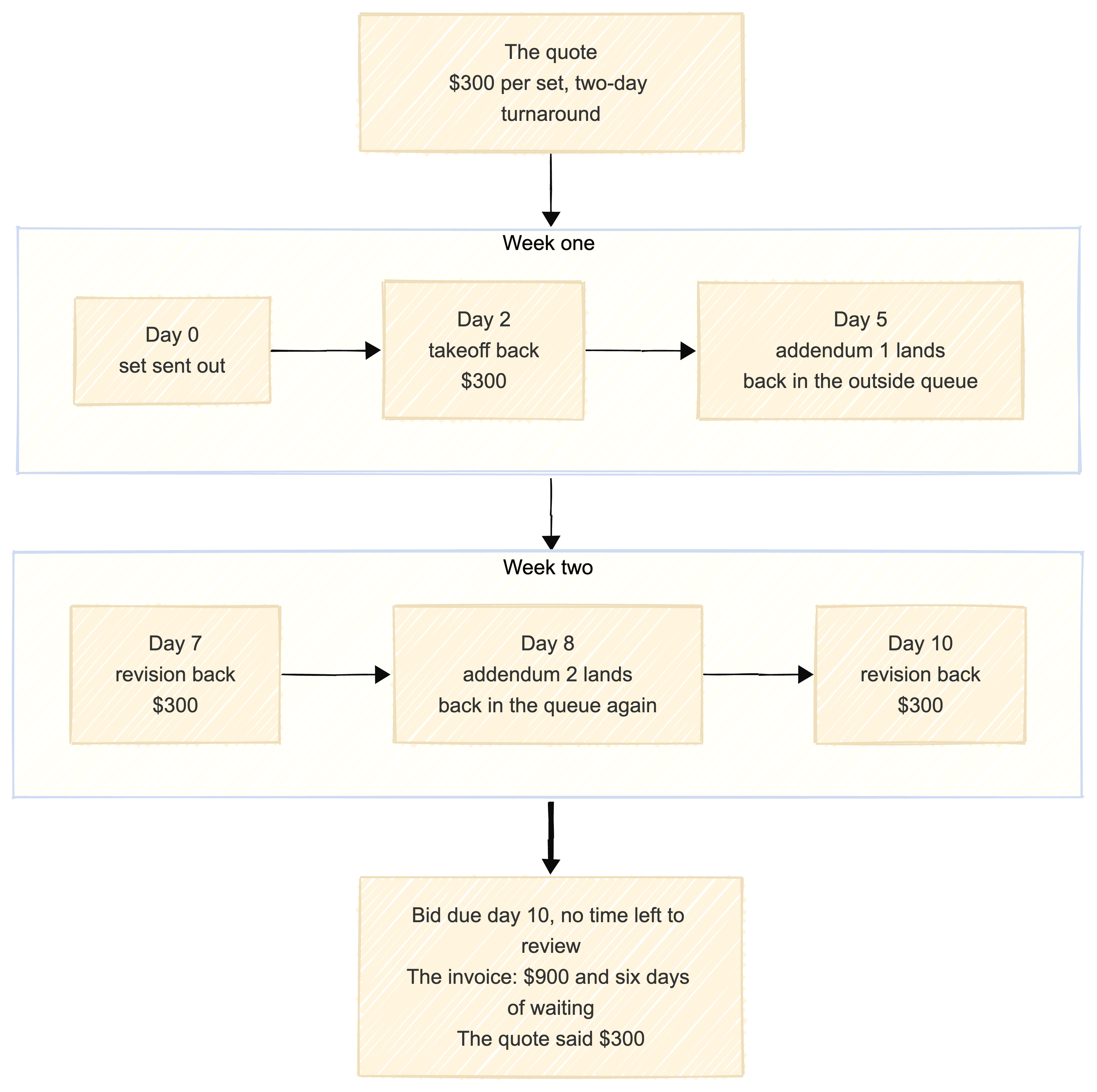
A takeoff is quoted as one transaction and delivered as several. An addendum lands four days before the bid, and the set goes back into an outside queue that has other customers ahead of you and may be nine time zones away. We hear this story from fabricators more than any other reason for dropping a service: a revision sat for two days, the bid went out on the old numbers or did not go out at all, and the job went to someone else. We wrote about where those days go in why steel estimators lose days to addendums.
Ask what a revision costs and how fast it comes back before you ask what the set costs. A firm that charges \(300 for the takeoff and treats each addendum as a new \)300 order on a two-day clock has quoted you \(900 and a week on a bid with two addenda. The quote said \)300. Some firms fold a revision or two into the price, and the quote rarely says which, so it is question two on the list further down.
The rush
Two to four business days is fine in July. In bid season every job is a rush, and the premium on the published benchmarks runs 20 to 50 percent. The rate you pay in the month you need the service most is the rush rate, and the rate on the quote is the one for the month you needed it least.
The win rate
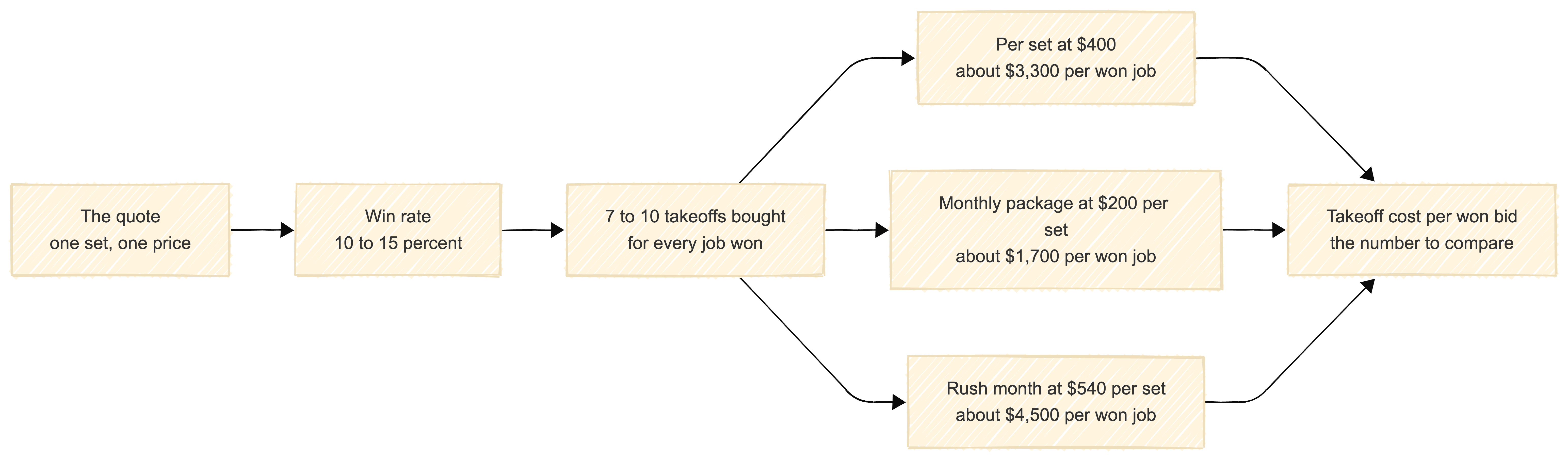
Most fabricators win somewhere between 10 and 15 percent of what they bid, so the shop pays for seven to ten takeoffs for every job it books. A price that looks like lunch money per set is a real line item per contract.
| Scenario | Cost per set | Sets per won job at 12 percent | Takeoff cost per won job |
|---|---|---|---|
| Per-set, mid-size | $400 | about 8 | about $3,300 |
| Monthly package, 5 sets | $200 | about 8 | about $1,700 |
| Rush month, per-set plus 35 percent | $540 | about 8 | about $4,500 |
Run your own win rate through that before you sign anything. The monthly package is the better deal at any real volume. The rush month is the one that should make you wince. For what those same sets would cost in your own estimator's hours, how long a structural steel takeoff takes has the by-hand ranges.
When paying for a takeoff service is the right call
Shops outsource takeoff services for good reasons, and some reading this should stop here and go buy one.
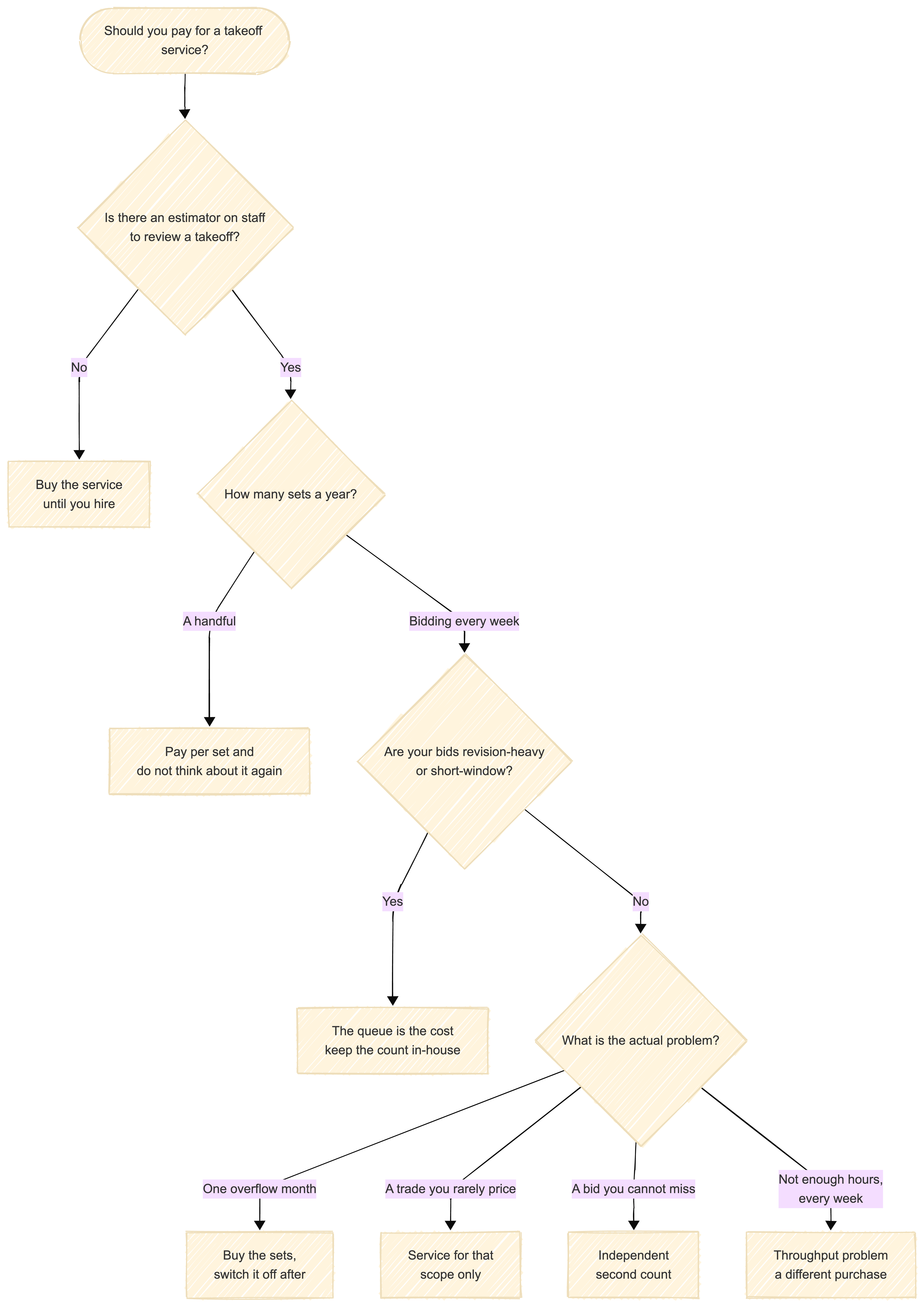
The clearest case is a shop with no estimator on staff. Takeoff software returns numbers that somebody has to review, and if nobody in the office can, the software is a liability. Hire the service until you hire the person.
Low volume is the second case. The package math above needs volume to work. A shop that sends out four sets a year should pay per set and not think about it again.
Then there is the overflow month, which is the thing a service does that a hire never can: buy the sets in March, keep your estimator on the bids that matter, and switch it off in April.
Two more, less obvious. A trade you rarely price, such as miscellaneous metals, stairs, or decking on a job that is mostly structural. An outside estimator who does that scope every week will beat your structural estimator doing it twice a year. And a second opinion on a bid you cannot afford to miss. A few hundred dollars for an independent count on a seven-figure number is the smartest use of a service I know.
When it is the wrong call
If the last three jobs each carried two or more addenda, you have a queue problem, and no per-set price fixes a queue.
Short bid windows are the same problem from the other side. A two-day turnaround on a five-day bid leaves your estimator one day to check a takeoff somebody else built, and the check is where the bid is won or lost.
Confidentiality deserves a plain sentence. Most services are professional about drawings and bid strategy, but some owner contracts restrict who may see a set, and you want to know where yours went before you find out from a lawyer.
The quieter reason is the one shops underestimate. Your estimator knows which connection types your shop runs cheap, which crane is booked through October, and which GC pays late. An outside count can be right and still produce a bid that is not yours, because that knowledge is what turns an accurate number into a competitive one, and it is not in the PDF you sent.
And if you bid every week with someone who knows steel, a service cannot fix your problem, because the problem is throughput, and that is a different purchase.
What to ask before you send a set
- Is this quote for a takeoff or a priced estimate?
- What does a revision cost, and what is the turnaround on one?
- What is the rush premium, and what counts as a rush?
- Who does the work, and where?
- What happens when the set has no column schedule? Do you build one, or count around it?
- Are connection types noted per beam end, or is it tonnage only?
- What format does the takeoff come back in, and can my estimator edit it?
- What are the confidentiality terms on my drawings?
A service that answers all eight without hesitating is one you can use. Question five is the one that sorts steel estimators from generalists, because sets without a column schedule are common and how a service handles one tells you whether the person counting has done this before.
The same money as software
The per-bid lens applies to software too, and the answer comes out differently.
Per-set pricing punishes a shop that bids a lot and wins a little, which describes most fabricators. A flat annual fee priced by the shop spreads across every set your estimator runs and does not go up in bid season. How steel estimating software is priced walks through the five models vendors use, and the same total-cost-per-bid comparison keeps their quotes honest.
There is a plainer way to see it. A takeoff service sells you hours of counting, and the $12 per hour row in the price table is a person clicking through your set one member at a time in Bluebeam or PlanSwift. AI detection does that counting in minutes. What remains is the review, and you were always going to keep that in-house.
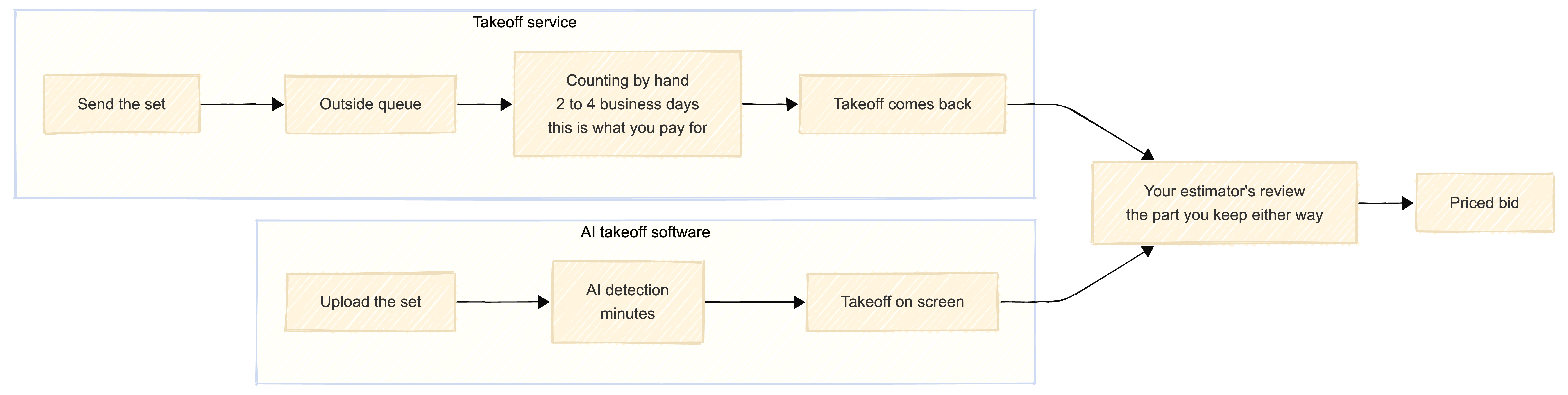
Which brings me to the limit. Software needs an estimator to review it. AI detection can take most of the counting off a good set, but the last few percent still matters, and that is why Ferra is built around estimator review rather than pretending the estimator disappears. If nobody in your shop can check the output, buy the service and skip the next paragraph.
For everyone else, this is the case we built for. Ferra is AI steel estimating software priced by the shop, with unlimited users and unlimited sets. It compares a revision against the earlier set inside the tool, so an addendum goes back through in minutes instead of back into a queue. The way to find out which row of the table your shop belongs in is to run it on your own drawings alongside your estimator and compare the result against how you work today.
If you are still weighing a service against a hire against software, the full three-way comparison is in outsource, hire, or buy software.
FAQs
How much does a structural steel takeoff cost?
Published 2026 pricing runs from around \(150 for a small single-trade set to \)900 for a mid-size commercial job and \(2,500 or more for a large or complex one, with monthly packages from around \)1,000 covering three to six sets a month depending on their size. Divide the per-set figure by your win rate to see what a takeoff service costs per job you book.
How do steel takeoff services charge?
Five models cover nearly every quote: a fee per set, a monthly package covering a fixed number of projects, a retainer that discounts per-set pricing by 20 to 40 percent, an hourly rate, and occasionally a rate per square foot. Rush turnaround of 24 to 48 hours adds 20 to 50 percent on top of whichever model you are on.
How fast can a takeoff service turn around a structural steel set?
Standard turnaround at the firms that publish it is two to four business days, and some advertise 24 to 48 hours at a rush premium. With many services a revision puts the set back into the outside workflow, which can add another turnaround cycle. With a service that queues and bills each revision, a bid with two addenda turns a two-day turnaround into six days of waiting spread across the bid window.
Is it cheaper to outsource a steel takeoff or use takeoff software?
It depends on volume and on whether you have an estimator to review the output. Below a handful of sets a year, per-set pricing wins and there is nobody to review software for. Above that, a flat fee spread across every bid costs less, provided somebody in the shop knows steel well enough to check the result.
Can ChatGPT do a structural steel takeoff?
Not reliably. A takeoff is a count off a column schedule, framing plans, and callouts spread across dozens of sheets, and a general chat model reads text rather than drawings. It will produce a confident answer and miss members. Purpose-built AI takeoff software reviewed by an estimator is a different category of tool. Steel-specific AI reads the drawings, and the estimator's review is what makes the output usable.
What is included in an outsourced structural steel takeoff?
Member marks, shapes, quantities, lengths, weight per foot, and tonnage by category, usually as a spreadsheet or PDF. Deck and miscellaneous metals are sometimes included and sometimes a separate line. Connection types per beam end and a priced estimate are usually extra, so ask before you assume the quote covers them.
If the hours are the problem and the judgment is already on staff, bring the messiest set you bid this quarter and we will run it with your estimator, then walk through what was detected and what needed a second look. Book the walkthrough, or sign up free and run a set yourself first.
Sources
- Veracity Estimating Services LLC, Structural Steel Estimating pricing page, accessed September 3, 2026. On-demand takeoff from \(150; monthly package from \)1,000 covering five to six small or medium projects or three to five medium or large; two to four day turnaround. This is the steel-specific Veracity site, and its plans differ from the company's other trade sites.
- World Estimating, metals estimating services page, accessed September 3, 2026. Around $200 typical for a steel and metals estimate, 24 to 48 hour turnaround.
- Takeoff Monkey, "How much do construction takeoff services cost in 2026", published January 10, 2026. Tiered per-takeoff ranges for general construction sets, 20 to 40 percent retainer discount, in-house estimator salary range.
- Quotr, "Quantity takeoff services: costs and when to outsource", updated August 26, 2026. Market range of \(150 to \)5,000 and up, 20 to 50 percent rush premium, and Quotr's own per-square-foot building-estimate pricing.
- Advance Estimating, construction takeoff services page, accessed September 3, 2026. Advertised at $12 per hour, working in PlanSwift, Bluebeam, and On-Screen Takeoff. The page does not state where the firm is based.
- Win rate range of 10 to 15 percent and revision turnaround patterns are as reported by fabricators in conversation with Ferra in 2026, stated without customer attribution.