
A takeoff is the count: every column, beam, joist, brace, connection, and misc item pulled off the drawings, with piece counts and tonnage. An estimate is what you do with that count, applying material prices, labor rates, coatings, freight, and margin to reach a bid number. In structural steel the takeoff is usually the slower half.
Key facts
- The takeoff answers "how much steel, and what kind." The estimate answers "what will it cost us to fabricate and erect it, and what do we bid."
- A takeoff is measured in pieces and tons. An estimate is measured in dollars and shop hours.
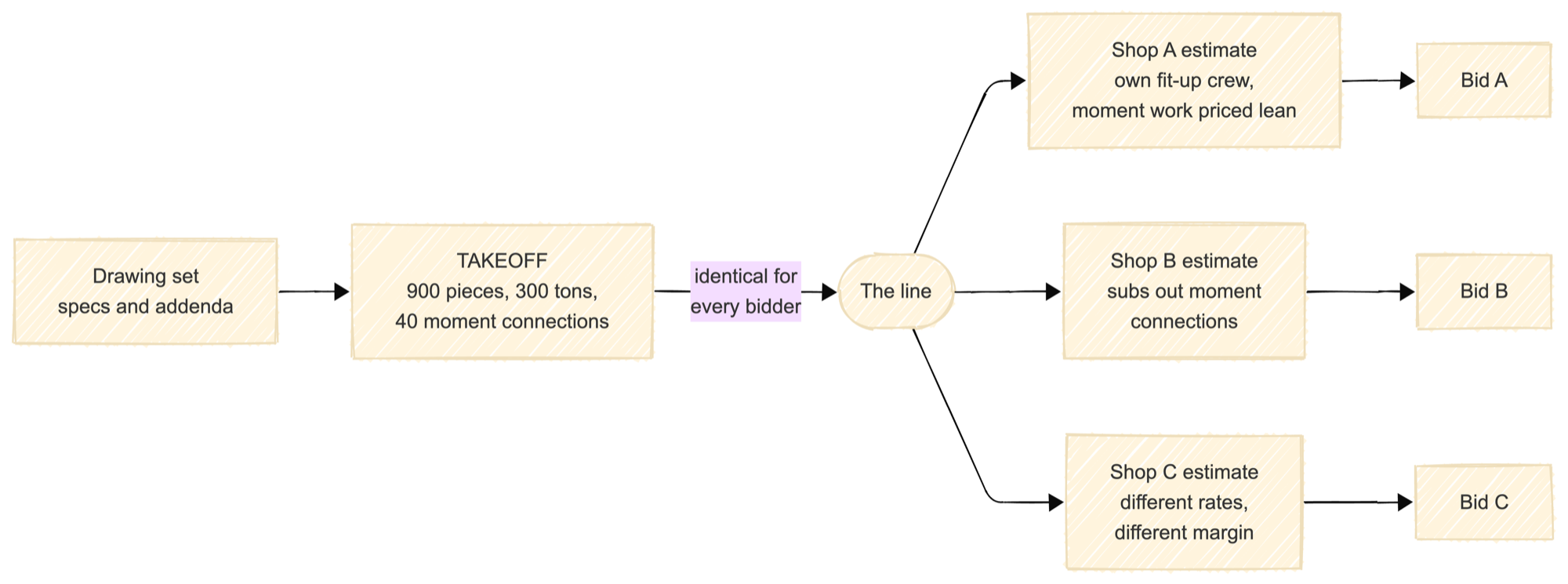
- The same takeoff can produce very different estimates at two shops, because labor rates, connection practice, and risk appetite differ.
- In structural steel the takeoff is usually the slower half. Columns and beams on one job routinely take days by hand.
- Software that asks you to type quantities in is estimating software. It assumes the takeoff already happened.
Side by side
| Takeoff | Estimate | |
|---|---|---|
| Input | The drawing set, specs, and addenda | The takeoff sheet plus your shop's rates |
| Output | Piece count, tonnage, BOM with marks and connection notes | Material, shop labor, coatings, freight, erection, margin, bid number |
| Unit | Each, feet, pounds, tons | Dollars, hours, dollars per ton |
| Who owns it | The estimator, often a junior for main framing | The estimator or chief estimator |
| Where it breaks | Missed members, wrong weight per foot, double counts across views | Wrong labor assumptions, mispriced connections, revisions not carried through |
Why the distinction matters when you buy software
Most products sold as "steel estimating software" price a count you already have. They are good at material, labor, and costing, and several of them live inside fabrication management systems. What they do not do is read four hundred sheets and produce the count. If your bottleneck is the days spent counting, an estimating module does not move it.
The first question to ask any vendor is where the quantities come from. If the answer is "you enter them," you are looking at the estimate half only.
The same question applies to an outside service. Most sell both halves and price them separately, so ask which one the quote covers.
Is takeoff part of estimating?
Yes. The takeoff is the first half of every steel estimate, and by hand usually the slower half. Some shops split the roles, with a junior running the count and a senior pricing it, but the estimate cannot start until the takeoff exists, and every pricing error traceable to a bad count started there.
Example
A 300 ton warehouse. The takeoff says 900 pieces, 300 tons, 40 moment connections, 20 tons of cambered beams with studs. That sheet is identical for every fabricator who bids the job. The estimate is not. One shop prices moment connections at a rate that reflects its fit-up crew, another does not have one and subcontracts. Same takeoff, different bids.
How Ferra handles this
Ferra covers the takeoff half: it reads the set, detects the members, and returns a reviewable count with tonnage and connection notes, which you then price in your own sheet or fabrication system. The split is described in more detail in the honest guide to structural steel estimating and in fabrication estimating software: why sheet metal tools break on structural steel.
Sources
- CSI MasterFormat, Division 05 Metals, for how steel scope is packaged in a bid.