
Not effectively. Sheet and plate tools price parts whose quantity is already known, using cut length, nest yield, and machine time. Structural steel needs the count derived from framing plans and a column schedule first, then shop hours that swing with connection type. A job shop tool has no concept of a W-shape or a moment connection.
Key facts
- Sheet and plate estimating tools price parts. The quantity is already known from a purchase order, and cost is driven by cut length, nest yield, and machine time.
- Structural steel is priced from a drawing set. The quantity has to be derived first, from framing plans and a column schedule, and cost is driven by tonnage and by shop hours that swing with connection type.
- A job shop tool has no concept of a W-shape, a column schedule, a moment connection, or a UNO note on sheet three.
- Most products that rank for "fabrication estimating software" are built for the first model. Read the feature list for the word "nesting" and you will know which one you are looking at.
- If you fabricate both, you may end up with two tools. One prices the plate work, the other does the structural takeoff.
The two models, side by side
| Sheet and plate estimating | Structural steel estimating | |
|---|---|---|
| Where quantity comes from | The PO or the part file | The drawing set, derived by takeoff |
| Unit of work | A part, a nest, a machine hour | A member, a connection, a ton |
| Cost drivers | Material utilization, cut length, bends, machine time | Tonnage, connection labor, coatings, misc metals, erection |
| Revisions arrive as | A new part file | A new full set, often at 30 and 60 percent |
| Typical output | Quote per part or per lot | Bid per job with qualifications and exclusions |
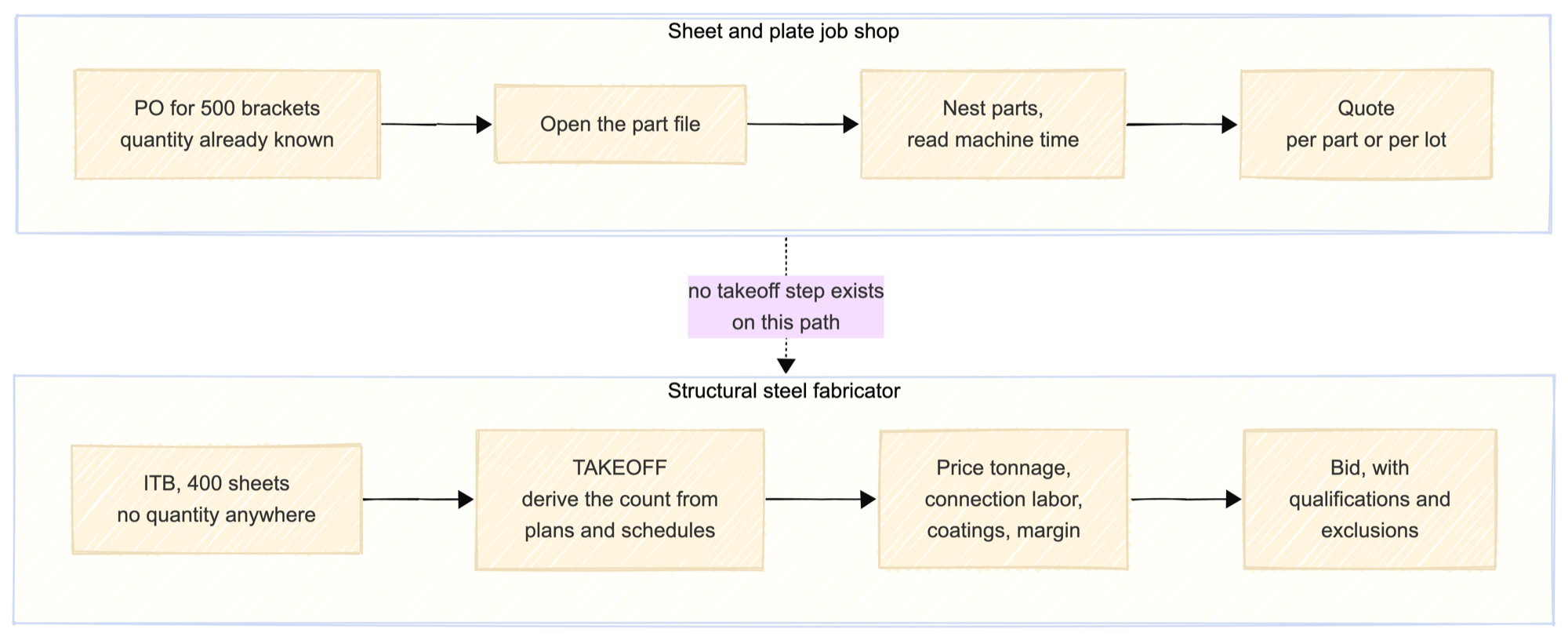
How do you tell which model a tool is built on?
Ask one question before anything else. Where do the quantities come from? If the software expects you to enter them, it prices parts and assumes the takeoff already happened. That is fine for a job shop. For a structural fabricator it means the slow half of the estimate, the days spent counting, is untouched.
Then ask it to handle a column schedule and a beam callout with camber and studs. A sheet metal tool cannot, because it was never meant to.
Example
A job shop gets a purchase order for 500 brackets. The estimator opens the part file, nests it, reads the machine time, and quotes. A steel fabricator gets an invitation to bid, four hundred sheets, and two weeks. The estimator has to find every member before a single price goes on anything. The industry calls both of those estimating, which is how the wrong tool ends up in a steel shop.
How Ferra handles this
Ferra is built for the second column of the table. It reads the drawing set, detects columns, beams, joists, and braces, and returns a takeoff for review, which you then price. The full argument, with the five things a sheet metal estimator never has to deal with, is in fabrication estimating software: why sheet metal tools break on structural steel.
Sources
- Sheet metal estimating vendor documentation, reviewed August 2026: the advertised feature set is nesting, part files, and machine-time costing, with no takeoff from drawings.
- CSI MasterFormat, Division 05 Metals, the scope a structural bid has to price.