
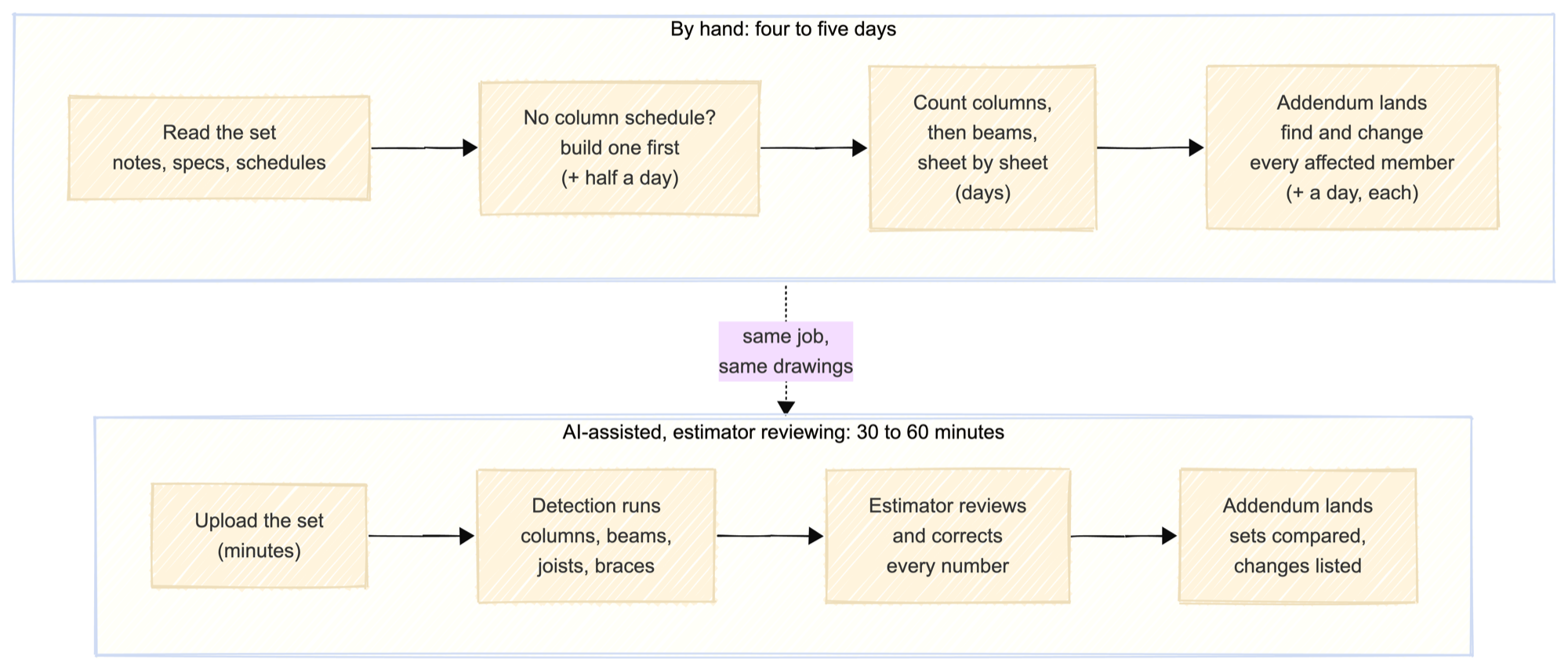
By hand, columns and beams on a mid-size commercial job take one estimator four to five days, with joists, braces, connections, and misc steel adding more, and each mid-bid addendum costing about a day. With AI-assisted detection and the estimator reviewing every number, the same scope finishes in under an hour, and 10,000-ton jobs in two to six hours.
Key facts
- By hand, columns and beams on a mid-size commercial job take an estimator several days. The estimators we talk to put it at four to five days, and the better part of a week is common when the set is large or incomplete.
- Each addendum that lands mid-bid costs roughly a day, because the beams already counted have to be found and changed.
- A single structural sheet takes close to an hour to work through manually, by one software vendor's own published figure. Multiply by the sheet count and the days add up fast.
- With AI-assisted takeoff and an estimator reviewing every number, the same job runs in under an hour. That is the number our customers report, and it is the only one we quote.
- Anyone promising a complete takeoff in ten minutes is overselling. Upload alone takes several minutes on a large set, and the review is the part that matters.
What makes a manual takeoff slow?
Three things, in order of how much they cost you.
The column schedule. When the set has one, columns come off it tier by tier. When it does not, and that is more often than you would think, the estimator builds the schedule from grid intersections and elevations before counting a single column. That alone can add half a day.
Sheet count and set quality. A clean vector PDF with consistent callouts reads quickly. A scanned set, a set with callouts pointing at details that do not exist yet, or a 30 or 60 percent design set slows every sheet down and forces judgment calls the estimator has to document.
Revisions. A takeoff does not stay finished. Addenda arrive before the due date, and each one means finding every affected member, changing it, and making sure a beam deleted in addendum one is not deleted again in addendum two.
Typical ranges
| Job | By hand | AI-assisted, estimator reviewing |
|---|---|---|
| Small job, a few sheets, column schedule present | Half a day to a day | 15 to 30 minutes |
| Mid-size commercial, columns and beams, no schedule | Four to five days | 30 to 45 minutes, up to an hour |
| Large or complex, 10,000 tons and up | One to three weeks | Two to six hours |
The by-hand figures are what the estimators we talk to report for columns and beams. Joists, braces, connections, and miscellaneous steel add to both columns of the table. The AI-assisted figures are what our customers report and include the estimator's review.
Why the review time is not optional
Detection on a good set runs in the mid nineties for accuracy out of the box. That last few percent is exactly the part that loses a bid: the column with no schedule entry, the cambered beam whose stud count moved in addendum two. The estimator checks it. Trust, but verify, is the standard, and the time for that check is inside every AI-assisted number above.
How Ferra handles this
Ferra reads the full set, detects columns, beams, joists, and braces, and returns a takeoff the estimator reviews and exports. Revisions are compared against the earlier set so the addendum day disappears. See Steel Takeoff, and for where the rest of a steel estimate's time goes, the honest guide to structural steel estimating and why steel estimators lose days to addendums.
Sources
- Ranges reported by fabricators using Ferra in 2026, including estimator review time, stated without customer attribution.
- ALLPLAN, published product material for Steel Genie, on manual processing time per structural sheet.