
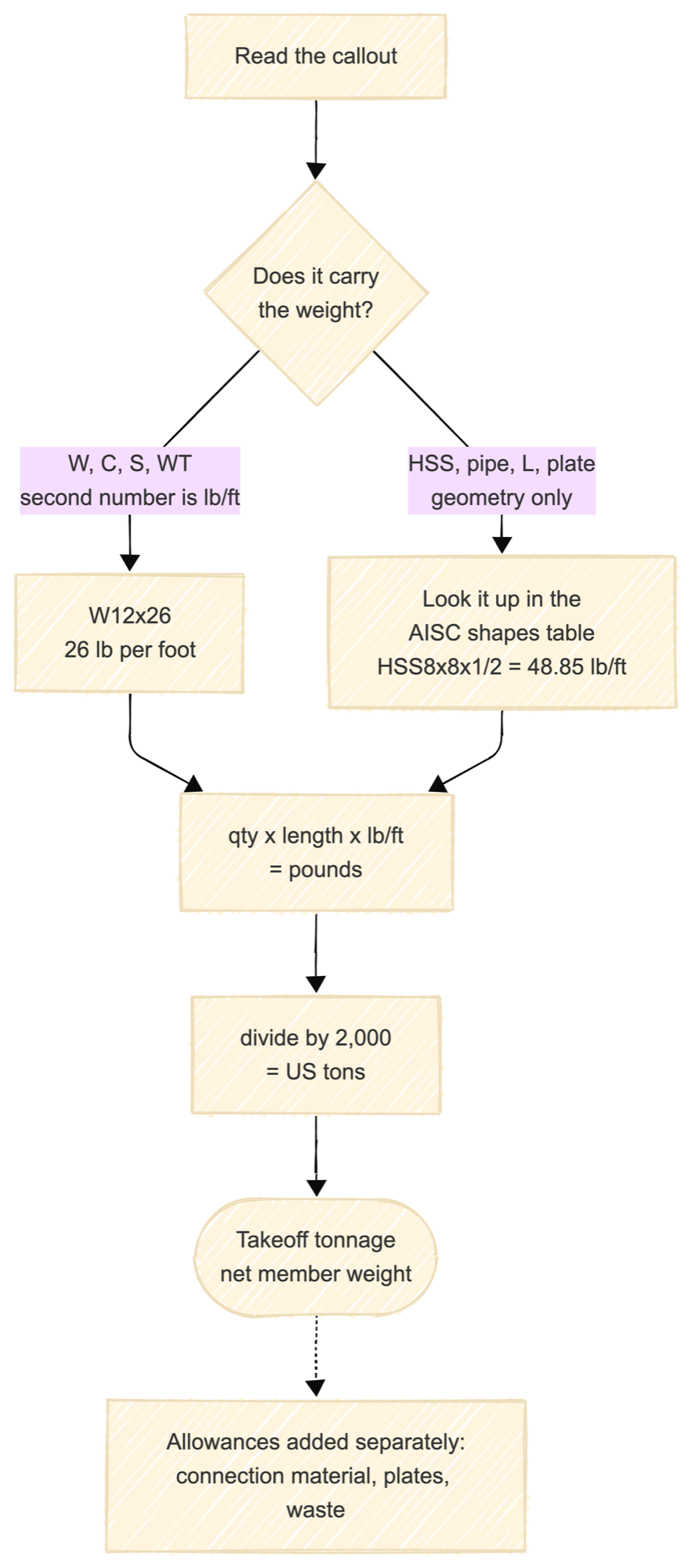
Multiply each line's quantity by its length in feet and by the shape's weight per foot to get pounds, sum every line, and divide by 2,000 for US tons. W, C, S, and WT callouts carry the weight per foot; HSS, pipe, angle, and plate weights come from the AISC shapes table.
Key facts
- The formula is quantity × length in feet × weight per foot = pounds. Divide by 2,000 for US tons.
- W, C, S, and WT callouts carry the weight per foot as the second number. A W12x26 is 26 pounds per foot.
- HSS and angle callouts give geometry only. The weight lives in the AISC shapes table and has to be looked up. An HSS8x8x1/2 is 48.85 pounds per foot, and nothing in the callout tells you that.
- Takeoff tonnage is the net weight of the members you counted. Connection material, plates, and waste are added afterward as an allowance, and how much is a shop decision.
- One wrong weight per foot repeats on every row that uses that shape. Check the lookup shapes twice.
Steps
- Finish the count first. Tonnage math on a moving count is wasted work. Settle columns, beams, joists, and braces before you multiply anything.
- Read the weight per foot off each callout. For W, C, S, and WT shapes it is the second number. W14x22 is 22 pounds per foot.
- Look up the shapes that do not carry a weight. HSS, pipe, angles, and plate need the AISC shapes table or a plate weight formula. Write the value on the sheet so it is not looked up twice.
- Multiply per row. Quantity × length × pounds per foot gives pounds for that line. Keep lengths in decimal feet so 30 feet 6 inches is 30.5, not 30.6.
- Sum the rows and divide by 2,000. That is the takeoff tonnage in US short tons. Metric jobs use kilograms per meter and divide by 1,000 for tonnes.
- Add allowances separately. Connection material, base and cap plates not already counted, and waste go on their own lines so the net member tonnage stays visible for later comparison.
Worked line
Twelve W12x26 beams at 30 feet each:
12 × 30 × 26 = 9,360 pounds. 9,360 ÷ 2,000 = 4.68 tons.
Six HSS8x8x1/2 columns at 14 feet, weight from the table:
6 × 14 × 48.85 = 4,103 pounds. 4,103 ÷ 2,000 = 2.05 tons.
Those two lines total 6.73 tons. A real sheet has hundreds of lines, which is why the math is kept in a spreadsheet or in the takeoff tool rather than on paper.
Where does tonnage math go wrong?
Three places, in the order we see them. A weight per foot copied from the wrong row of the table. A length measured to the face of a column on one beam and to the centerline on the next. And members counted twice because they appear on a plan and again on an elevation. None of these are math errors. They are count and lookup errors that the math faithfully multiplies.
Do HSS callouts include the weight?
No. An HSS callout such as HSS8x8x1/2 gives outside dimensions and wall thickness only. The weight per foot lives in the AISC shapes table or the Steel Tube Institute's dimension tables, which is why every HSS line on a takeoff is a lookup you can get wrong. The same is true of pipe, angles, and plate.
How Ferra handles this
Ferra reads the shape off each detected member, applies the weight per foot from the AISC catalog, and totals tonnage as the estimator reviews the count. Lookup shapes like HSS and angles are resolved from the same catalog, so the table error above cannot happen. See Steel Takeoff.
Sources
- AISC Shapes Database v16.0, weight per foot for every listed designation.
- Steel Tube Institute, ASTM A500 HSS dimensions and section properties, the lookup table behind the HSS weights.