
Shear studs are headed steel pins welded to a beam's top flange, usually through the metal deck, so the concrete slab and the beam act as one composite member. The count rides the beam callout, such as W18x35 (26), and it belongs in the takeoff: missed studs across a floor are real money.
Key facts
- Shear studs are headed steel pins welded to the top flange of a beam, through or before the metal deck, so the concrete slab and the beam act as one composite member.
- Common sizes run 5/8, 3/4, and 7/8 inch diameter, with 3/4 the commercial default; length is set by the deck profile plus the embedment above it. The studs themselves are Type B headed studs of ASTM A108 material.
- The count rides the beam callout: W18x35 (26) means that beam gets 26 studs. Some sets note studs per foot or per half-span instead.
- Studs are installed with a dedicated stud welding gun, often by a specialty crew at the site rather than in the shop.
- For the estimator, studs are a count that hides in plain sight. Missing the parenthetical on a hundred beams is thousands of dollars of scope.
What they do
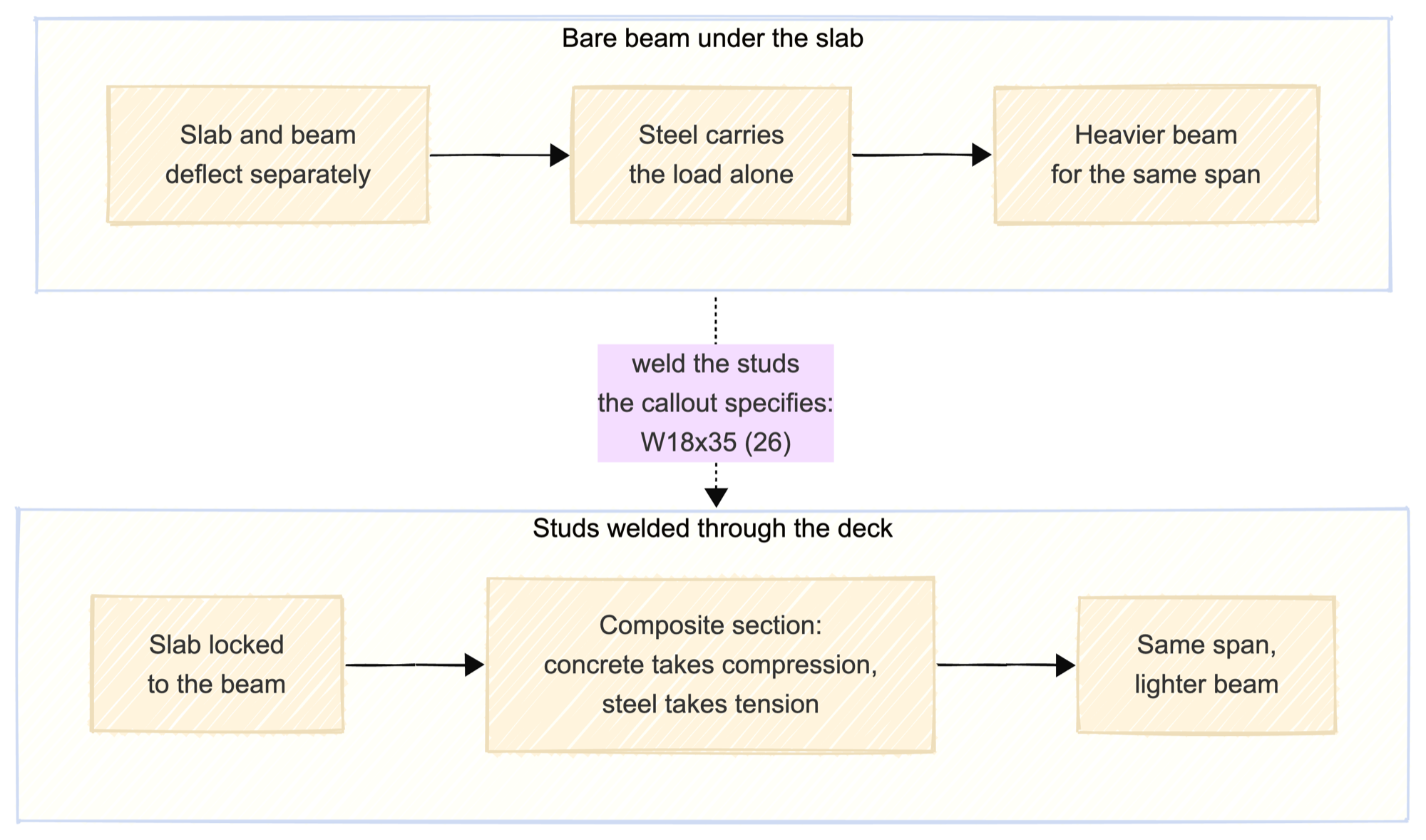
A bare steel beam and the slab on top of it deflect separately. Weld studs along the flange and the slab is mechanically locked to the beam, so the pair works as a composite section: the concrete takes compression, the steel takes tension, and the same span carries more load on a lighter beam. That is why composite floors dominate commercial framing, and why the stud counts are not optional decoration. On a member designed as composite, the engineer sized the beam assuming the studs exist. A beam with no parenthetical is usually non-composite, and adding studs it does not call for is scope nobody asked for.
How they show up in a takeoff
As a per-beam count that must be captured with the member, not as a separate line guessed later. The callout convention varies: a parenthetical total on the beam line, a note like "44 studs equally spaced," or a typical note in the general notes that covers whole levels. Cambered beams and stud-heavy beams travel together on the same floors, which is why a takeoff sheet carries camber and stud columns side by side. Total stud count drives material, welding time, and the specialty crew's mobilization, and a changed parenthetical is exactly the kind of quiet edit addenda carry.
Are shear studs the same as Nelson studs?
Same object, different names. AISC 360 calls them steel headed stud anchors, the trade says shear studs or shear connectors, and Nelson is the brand name that became generic, the way Bluebeam did for markup. A spec that says Nelson studs and a callout that says headed studs are describing the same parenthetical.
Who furnishes the shear studs?
The bid question the count does not answer. Studs can sit in the steel fabricator's package, ride with the metal deck package, or belong to a stud-welding subcontractor mobilized by either. All three arrangements are common, so the takeoff counts them and the bid states whose number they are. The two failure modes are mirror images: two trades both carrying 2,000 studs, or neither.
Example
Eighty composite beams at (26) each is 2,080 studs. Miss the parenthetical while counting beams and the takeoff is short 2,080 field-welded attachments, their material, and the welding crew's day rate, without a single beam missing from the count. That is why the stud column sits on the takeoff sheet next to camber instead of being a note somewhere.
How Ferra handles this
Ferra reads the stud count off each detected beam callout and totals it with the takeoff, and its revision comparison flags beams whose stud counts changed between issues, which is one of the quiet changes clouds tend to miss. See Steel Takeoff.
Sources
- AWS D1.1, Structural Welding Code, Steel, the stud welding requirements and qualification; studs are Type B headed studs per ASTM A108.
- AISC 360, Specification for Structural Steel Buildings, Chapter I, where composite member design assumes the specified steel headed stud anchors.