
Steel estimating software is sold five ways: per seat, per trade license, per takeoff or per sheet, as a flat annual subscription, or as a module inside a fabrication management system. Almost no vendor publishes list prices. The total depends more on user and project caps, implementation, and the annual layer than on the headline figure.
Key facts
- Almost no vendor in this category publishes a list price. Neither Trimble, for Tekla PowerFab, nor STRUMIS publishes one. The figures floating around online are other shops' old quotes, not something you can hold a salesperson to.
- Five models cover nearly every quote you will see: per seat, per trade license, per takeoff or per sheet, flat subscription, and a module inside a fabrication management system.
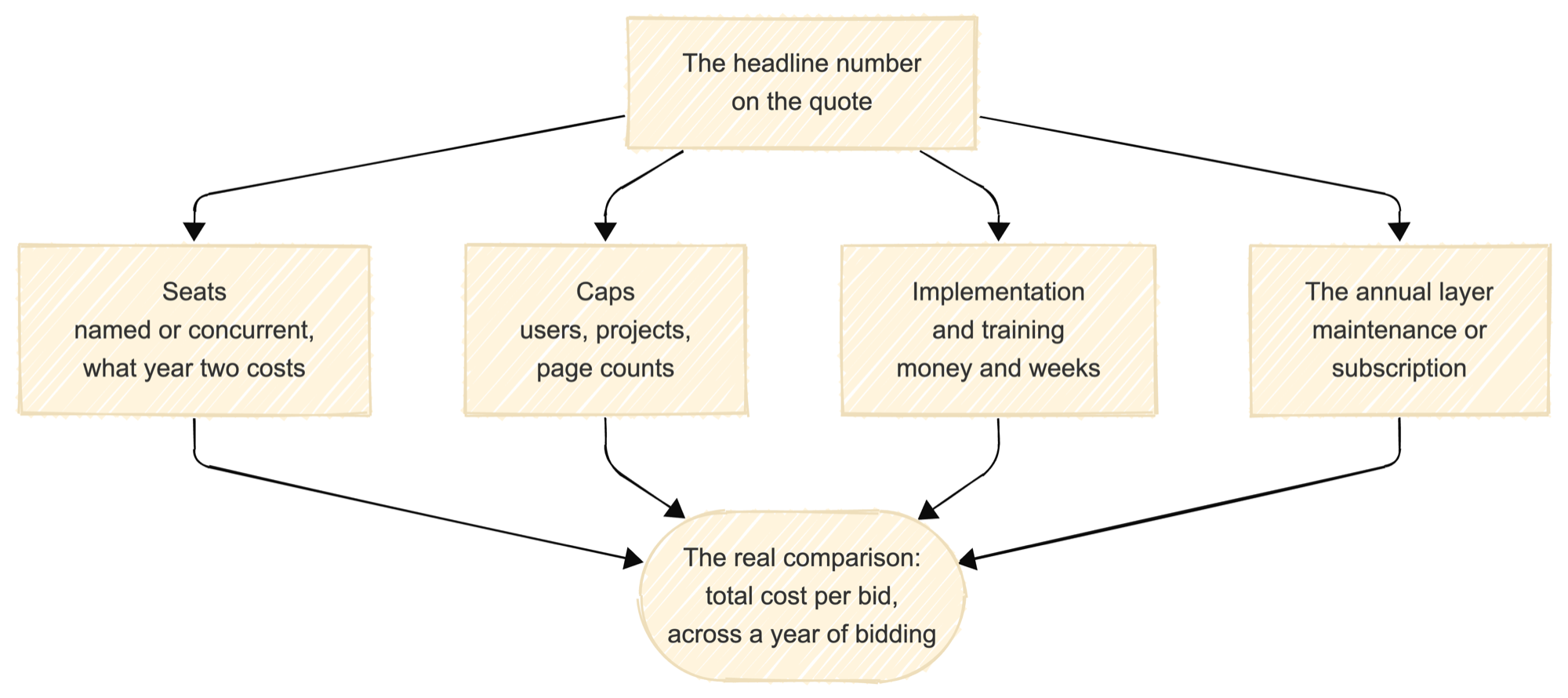
- The headline number is rarely the total. Caps on users, projects, or pages, implementation and training, and the annual maintenance or subscription layer move it more than the list price does.
- Per-seat pricing punishes a shop with several estimators. Per-takeoff pricing punishes a shop that bids a lot and wins a little, which describes most of them.
- Two quotes for "the same" category can differ by a multiple and both be honest. They are built from different parts.
The five models
| Model | How it scales | Who it suits | Watch for |
|---|---|---|---|
| Per seat | Number of named or concurrent users | A one or two estimator shop | Seat price in year two, named vs concurrent |
| Per trade license | One fee per trade you estimate | Multi-trade estimating groups | Structural steel depth inside a generic tool |
| Per takeoff or per sheet | Volume of sets you run | Low bid volume, occasional steel | Cost per bid when win rates sit near 10 to 15 percent |
| Flat subscription | A fixed annual fee, sometimes tiered by shop size | Shops that bid a lot with a team | What the tier is tied to, and caps hidden inside it |
| MIS module | Part of a larger production system quote | Shops already buying an MIS for the floor | Whether the module does takeoff at all, or only pricing |
The MIS-module row is also where shops discover they were comparing one product against its own earlier version.
Questions that make quotes comparable
- Is this per named user or per concurrent user, and what does one more seat cost next year?
- Are users, projects, or page counts capped, and what happens at the cap?
- Is implementation and training in this number, and how long does it take a shop my size?
- What is the annual maintenance or subscription after year one?
- Where do the quantities come from? If I type them in, I am buying an estimate tool, not a takeoff tool.
- If we leave in three years, what do we get out, and in what format?
A vendor who dodges any of the six is answering a different question, and you should hear it that way.
Example
A four-estimator shop gets two quotes. The first is per seat and looks cheap until four seats and the second-year increase are on paper. The second is a flat annual fee that looks expensive until you divide it by the 300 bids the shop runs a year. The cheap quote was the expensive one. You only find that out by putting both on the same scope.
How Ferra handles this
Ask us the same six questions. We price by the shop, not by the seat, and we would rather you compare on total cost per bid than on a headline figure. The tool-by-tool view, including how each product is sold, is in the best AI structural steel estimating software in 2026, and the anatomy of a fabrication management quote is in Tekla PowerFab vs STRUMIS vs FabSuite.
Sources
- Vendor pricing and licensing pages reviewed August 2026; where a vendor publishes no price, none is stated here.