
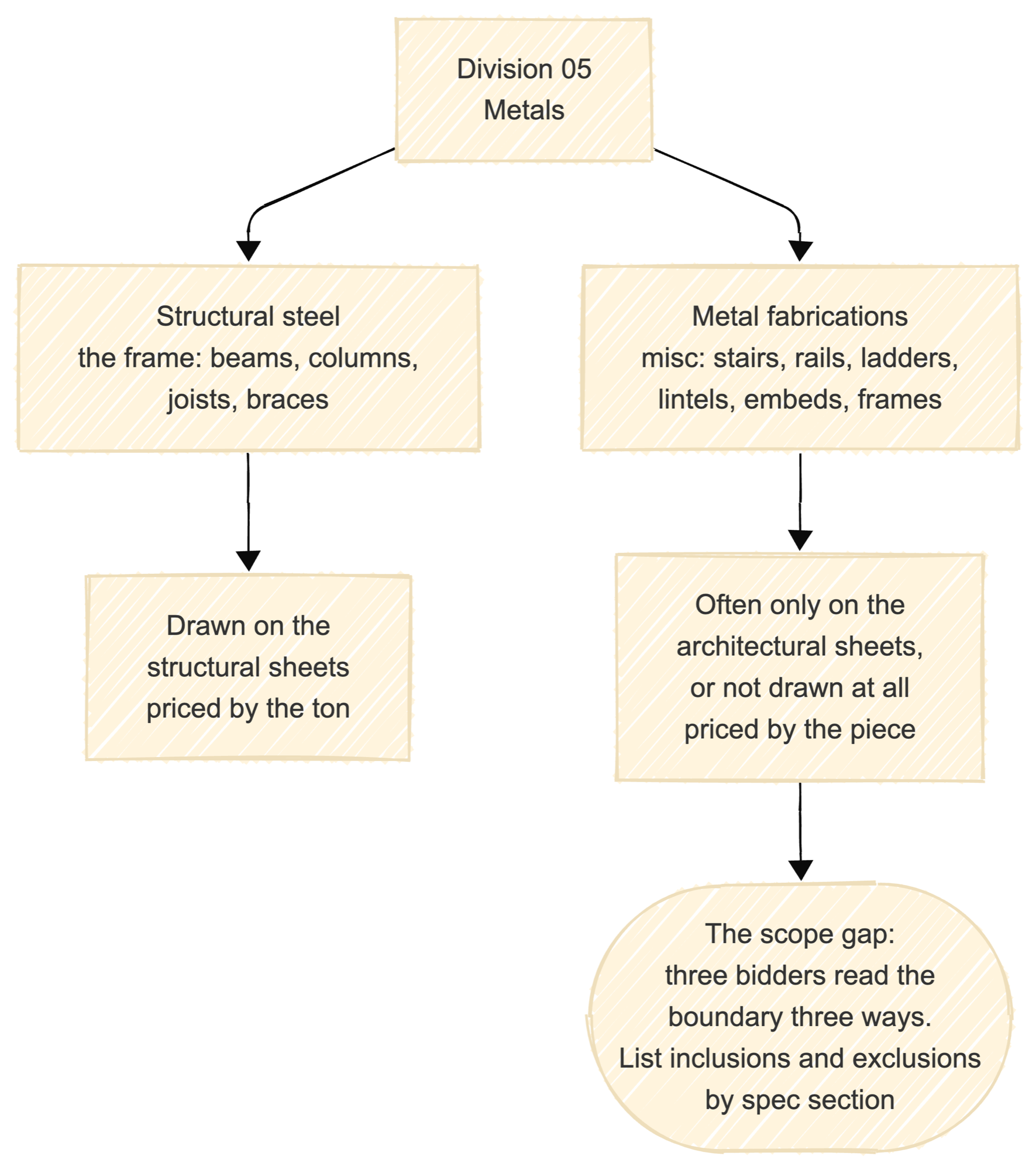
Miscellaneous metals is the fabricated metal work outside the main frame: stairs, railings, ladders, lintels, embeds, and support frames, specified under Division 05 metal fabrications. It is labor-dense and priced by the piece rather than the ton, much of it is drawn late or not at all, and scope gaps between trades live here.
Key facts
- Miscellaneous metals, or misc steel, is the fabricated metal work that is not the building's main frame: stairs, railings, ladders, lintels, embeds, bollards, gates, and support frames.
- In CSI MasterFormat it lives in Division 05 under metal fabrications, a separate spec section from structural steel framing.
- It is labor-dense. Pound for pound, a stair carries far more fabrication hours than a beam, which is why misc is priced by the piece, not by the ton.
- Much of it is drawn late or not at all. Lintels and embeds routinely exist only in typical details and architectural sections at bid time.
- Scope gaps live here. Whether misc metals belongs to the steel fabricator, a specialty shop, or another trade is decided by the spec sections, and assumed wrong constantly.
What counts as misc
The working list on a commercial job: stairs and their pans, stringers, and handrails; guardrails and railings; ships ladders and cages; loose lintels over openings; embed plates and anchors cast into concrete; elevator pit ladders and sill angles; dunnage and equipment support frames; bollards; trash gates and miscellaneous frames. Some jobs pull ornamental work into its own package. The boundary between structural and misc is the spec, not the material: the same angle is structural in a braced frame and misc as a shelf lintel. The numbers that draw the boundary:
| Spec section | Covers | Boundary note |
|---|---|---|
| 05 12 00 | Structural steel framing | The frame, priced by the ton |
| 05 21 00 | Steel joists | Not misc: a supplier package |
| 05 31 00 | Steel decking | Not misc: a supplier package |
| 05 50 00 | Metal fabrications | The misc core: stairs, rails, ladders, lintels, embeds |
| 05 51 00 / 05 52 00 | Metal stairs / railings | Often broken out inside misc |
| 05 70 00 | Decorative metal | Ornamental, sometimes its own bid |
Why it is priced differently
A ton of misc might be two hundred small pieces, each cut, fit, welded, and finished, many galvanized or painted, most installed by hand. Tonnage-based pricing collapses on that math, so misc gets estimated piece by piece, assembly by assembly: a stair flight as a unit, a railing by the linear foot, embeds by the count. That is also why misc has its own shop hours reality, far above rolled-shape work, and why a bid that swept misc into the structural tonnage rate underpriced it.
Is a lintel structural steel or miscellaneous metals?
Both, and AISC 303 Section 2 draws the line: a lintel attached to the structural frame is structural steel, and a loose lintel, shipped to the site and set by the mason over an opening, is not. Same angle, same steel, different package. This is the one distinction worth memorizing, because loose lintels are the classic item two bidders both excluded and nobody bought.
Are joists and deck miscellaneous metals?
No. Open-web joists and metal deck carry their own spec sections and usually arrive as supplier packages, priced and bought separately from both the frame and the misc. GCs still sweep them into "the steel number," which is why a steel bid states whether joists and deck are in, out, or by others.
The scope-gap problem
The architectural drawings show a stair. The structural drawings do not. Spec section 05 50 00 says metal fabrications, the steel package says structural steel, and three bidders read the boundary three ways. The protection is explicit scope language: list the misc items included, list the ones excluded, and cite the spec sections either way. On the estimating side, misc has to be counted from the architectural set too, because the structural sheets alone will not show it.
How Ferra handles this
Ferra's takeoff today covers the structural frame: beams, columns, joists, and braces. Miscellaneous metals detection is in development with fabricator design partners. Bid Intelligence already reads the full document set, including the architectural sheets and Division 05 specs where misc scope hides, and flags it for the estimator. See Bid Intelligence.
Sources
- CSI MasterFormat, Division 05, metal fabrications and ornamental metal sections.
- AISC 303, Code of Standard Practice for Steel Buildings and Bridges, Section 2, on what the definition of structural steel includes and excludes.