
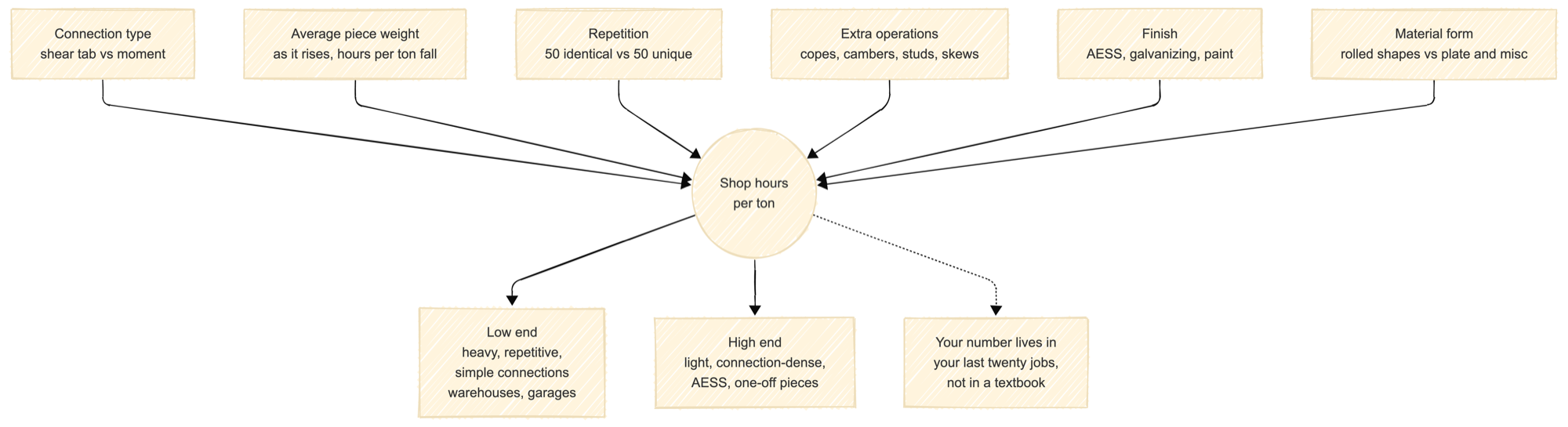
Shop hours per ton is fabrication labor divided by tonnage, and it moves with connection type, average piece weight, repetition, extra operations such as copes, cambers, and studs, finish requirements like AESS or galvanizing, and material form. Two jobs of equal tonnage can differ widely, which is why the number has to come from your own job history.
Key facts
- Shop hours per ton is fabrication labor divided by tonnage. It is the number that turns a takeoff into a labor estimate, and it is specific to your shop.
- Two jobs with identical tonnage can carry very different shop hours. Connections are the usual reason.
- Heavy, repetitive members with simple connections sit at the low end. Light, connection-dense framing, AESS, and one-off pieces sit at the high end.
- Piece count predicts shop hours better than tonnage does. Every piece is handled, fit, welded or bolted, inspected, and loaded, regardless of what it weighs.
- Publishing a single industry figure would be misleading. The range across shops is wide, and the only number worth bidding on is the one from your own job history.
What moves the number
Connection type. A shear tab is a plate and a few bolts. A moment connection is full-penetration welds, backing bars, inspection, and often stiffeners, and it can take several times the labor of a simple shear connection on the same beam. The takeoff has to note the connection type per beam end or the estimate cannot see this.
Piece weight. A W36x330 at 60 feet is just short of ten tons in one pick. A W8x10 at 8 feet is 80 pounds. Both are one piece to fit, one piece to weld, one piece to load. Average piece weight is the fastest sanity check on a labor estimate: as it rises, hours per ton fall.
Repetition. Fifty identical beams get faster as the shop goes. Fifty unique beams do not. Warehouses and parking garages run lean on this. Renovation sets and architectural work do not.
Fabrication complexity beyond connections. Copes, holes, cambers, shear studs, skewed or sloped framing, and built-up members each add an operation. Stud counts in particular hide in the beam callout and get missed.
Finish and appearance. AESS grinds welds smooth and controls tolerances the shop does not normally hold. Galvanizing adds handling and venting details. Shop paint versus primer changes the paint line load.
Material form. Plate work, built-up sections, and miscellaneous metals such as stairs and rails carry far more labor per ton than rolled shapes, which is one reason misc steel is priced separately.
Why it has to come from your shop
The same 300 ton job will run a different number of hours at a shop with a beam line and a fit-up crew that does moment connections every week than at a shop that subcontracts them. Your rates, your equipment, your crew, and your quality requirements are the denominator. Historical job costing is the only source that reflects them. A figure borrowed from a textbook or another shop tells you what their shop would bid.
How to get a defensible number
Pull the last twenty jobs from job costing. Split them by type: light commercial, industrial, connection-heavy, AESS, misc. Divide shop hours by tons for each. The spread inside each bucket is your real uncertainty, and the bucket averages are your starting point for the next bid. Then check every new estimate against the nearest bucket before it goes out.
How Ferra handles this
Ferra records the connection type at each beam end, the stud and camber callouts, and the piece count alongside tonnage, so the labor estimate can see the drivers above instead of pricing against tonnage alone. The longer treatment of why connections change the price is in steel connection types explained: shear tabs, moment connections, gusset plates, and what they cost you in the shop.
Sources
- AWS D1.1, Structural Welding Code, Steel, the weld and inspection requirements that make a moment connection cost more than a shear tab.
- AISC 303, Code of Standard Practice for Steel Buildings and Bridges, Section 10, the tolerance and finish requirements behind AESS labor.