
How to read and take off steel joists and joist girders
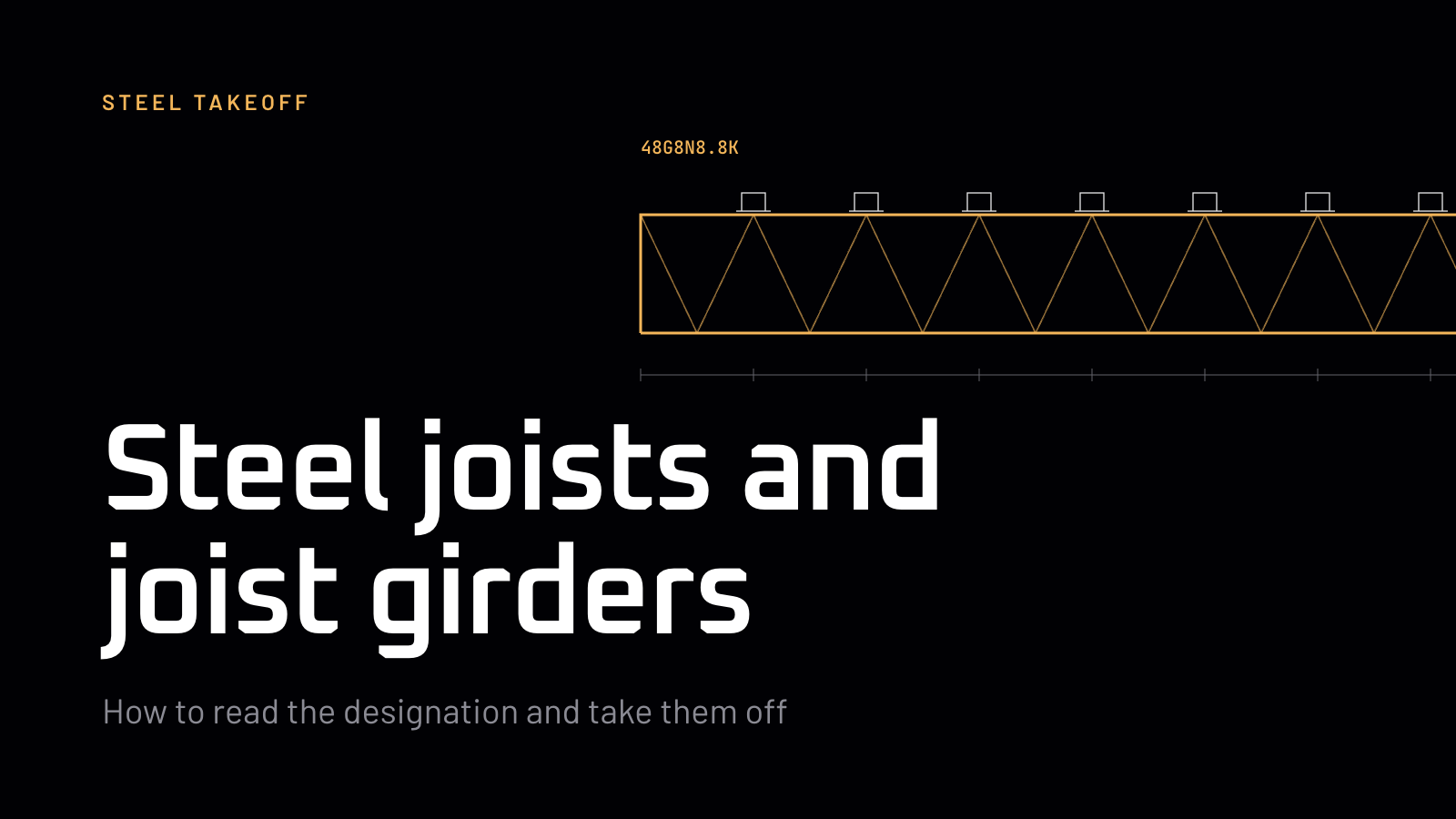
A steel joist designation tells you the depth, the series, and either a chord section or the load the joist carries. For an estimator, that's only the start. You still need the weight per foot, and the plan often doesn't give it to you directly.
We were onboarding a new customer earlier this year. During the session, one of their estimators stopped us with a question.
"So, you don't count the joists?"
We didn't, not yet. I dropped a screenshot of the beta into the chat. They said they'd use it on their erect-only jobs, just to get rough piece counts on the joists and deck.
It's a fair question. If your takeoff stops at the beams and columns, you're doing the joists by hand, and on a joist roof that's a lot of pieces.
A steel joist, also called a bar joist or open web steel joist, is a lightweight steel truss. It carries a floor or roof deck between beams, joist girders, or walls. This post is for the estimator who has to read them off the plan and price them.
Bar joist vs joist girder
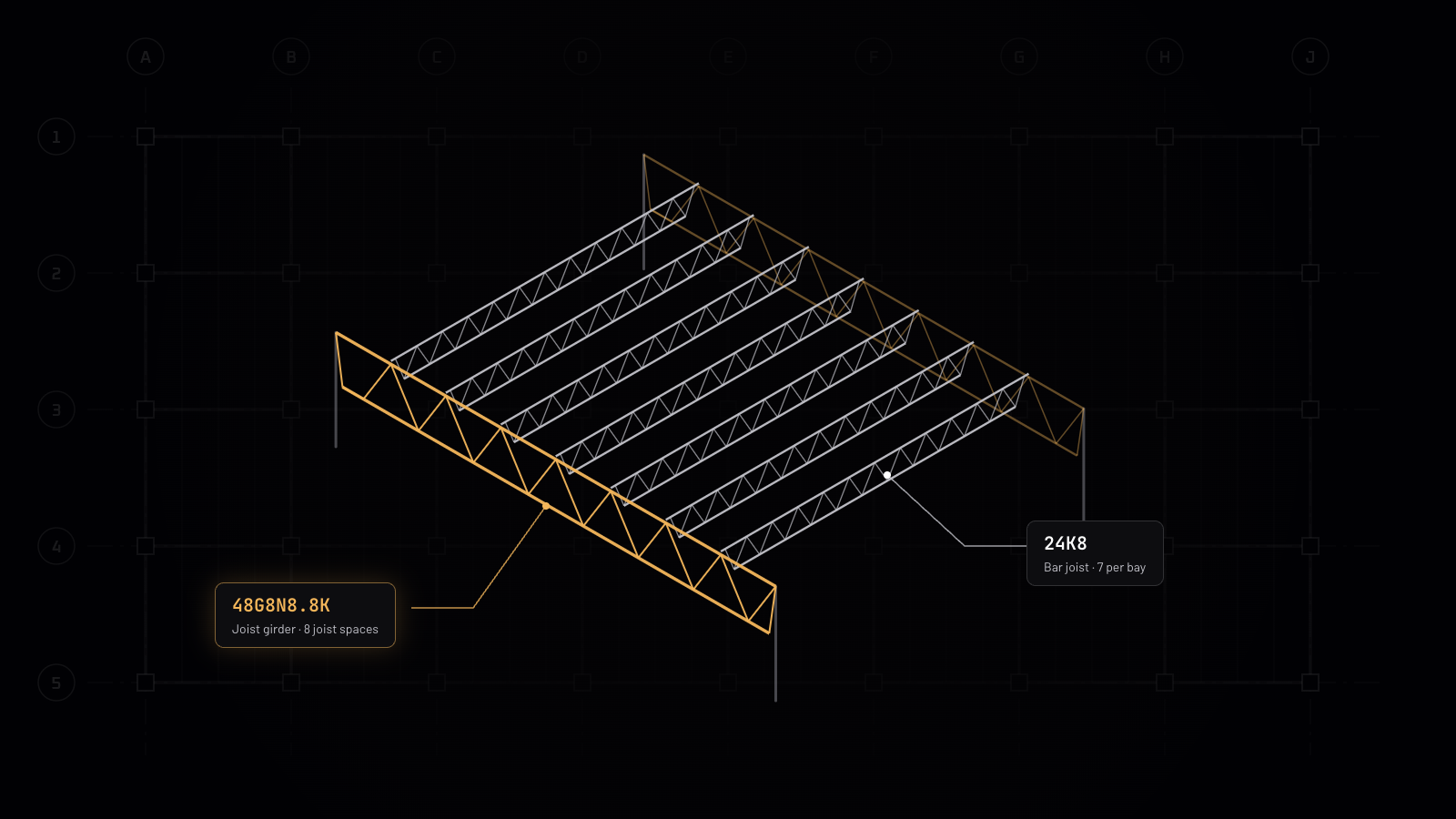
A bar joist carries the deck. A joist girder carries the joists.
The joists sit on the girder at evenly spaced points, called panel points. The girder then frames into the columns. On a big roof you'll see rows of bar joists running one way and joist girders running the other.
On a takeoff, the girder is the one to watch. It's often drawn like a beam, a single line with a callout. Count it as a beam and you've priced it at the wrong rate and probably the wrong weight.
How to read a steel joist designation
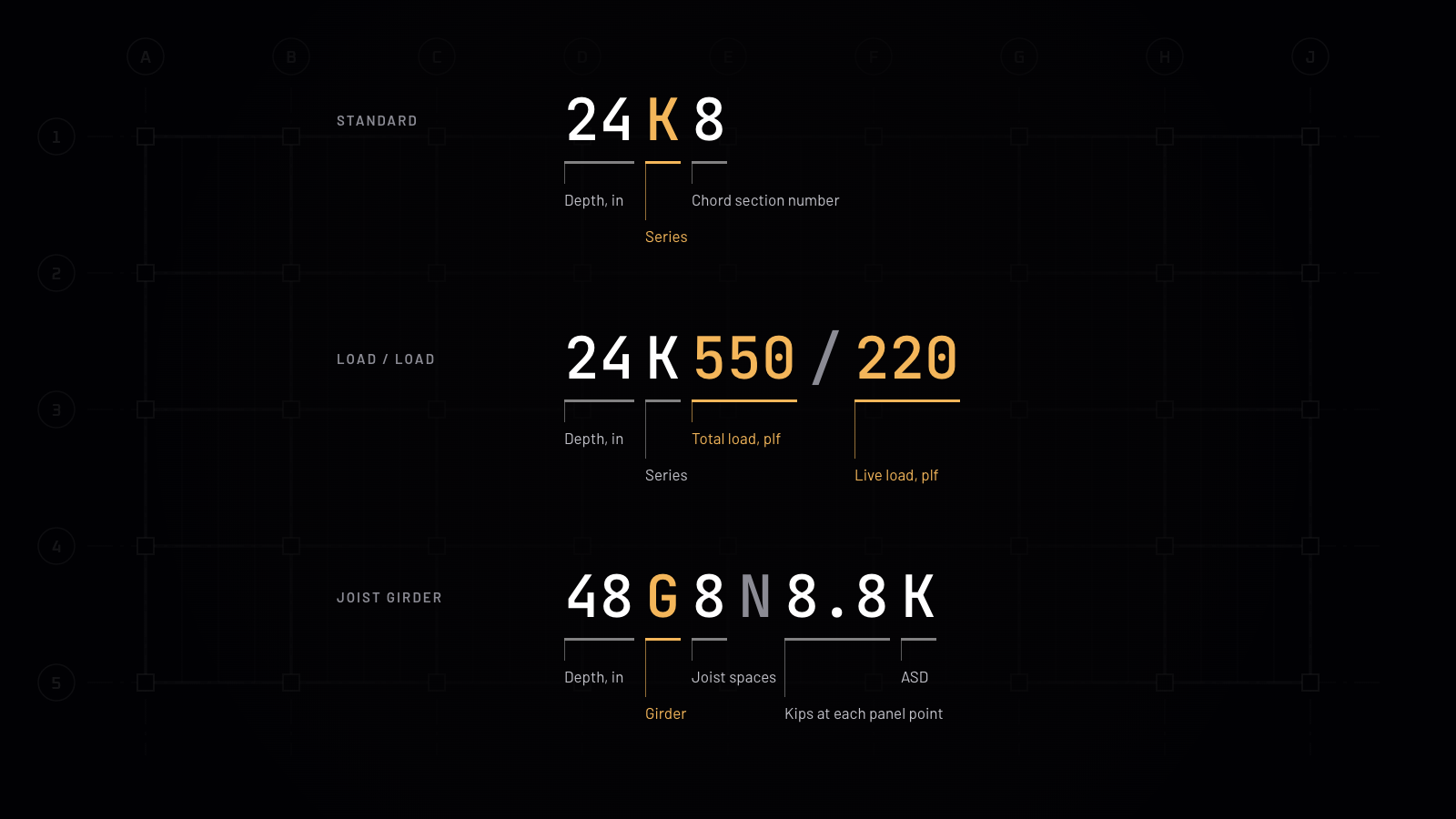
A standard designation reads depth, then series, then section number. So 24K8 is a K-series joist, 24 inches deep, with chord section number 8.
The Steel Joist Institute sets the formats. These are the ones that show up on framing plans.
| Callout | What it means | Where the weight comes from |
|---|---|---|
| 24K8 | K series, 24 in deep, section 8 | The K-series load table |
| 28LH09 | Long span, 28 in deep, section 09 | The LH load table |
| 52DLH13 | Deep long span, 52 in deep, section 13 | The DLH load table |
| 24K550/220 | K series, 24 in deep, 550 plf total load, 220 plf live load | The load tables, using the span |
| 20KCS3 | K series designed for constant moment and shear capacity, to carry uniform plus concentrated loads | The KCS load table |
| 48G8N8.8K | Joist girder, 48 in deep, 8 joist spaces, 8.8 kips at each panel point | The girder weight tables, as an estimate |
| 30CJ1500/800/300 | Composite joist, 30 in deep, with factored loads | The supplier's design |
K joists cover the shorter spans. LH and DLH go deeper and longer. The exact depth and span ranges are in the current SJI standard. SJI 100-2025 replaces the 2020 edition on December 1, 2026, so check it before you lean on a range.
Load/load callouts skip the section number. The engineer gives the depth and two loads in pounds per linear foot, total and live, and the joist supplier designs a joist to carry them. Subtract live from total and you have the dead load.
Joist girders read differently. G marks the girder. The number before N is how many joist spaces it has, and the number after N is the load at each panel point, in kips.
Composite joists are their own thing, covered by a separate standard, SJI 200. A CJ callout lists factored loads in the order total, live, dead, so don't read it like a K or LH load callout. Some suppliers also have their own series, like Vulcraft's SLH for special long LH and DLH joists. For those, use that supplier's data.
How to find the weight of a steel joist
This is where joist takeoffs slow down.
A standard designation is the easy case. The SJI load tables list an approximate weight per foot for each section. Multiply by the length and you're done. That weight leaves out accessories such as bridging, so those go on top.
A load/load callout needs one more step. The weight depends on the span, so the same callout can weigh a different amount per foot at 12 ft than at 20 ft. You measure the length off the plan, find the right row in the load tables, then get the weight. On a roof with a few hundred joists, that's a lot of lookups.
Joist girders have weight tables too, but they're published as estimating aids.
Then there are custom-engineered joists. We asked Michael Gu, our co-founder, which joist mistakes he sees most on steel bids. This was one of them: "Sometimes joists need to be custom engineered depending on the project, which means the pounds per lineal foot is not standard." No table gives you that weight. It comes from the loads, so watch the plan for them. An SP after the designation, like 28LH400/200 SP, is one sign. You estimate those and mark them.
All of it is an estimate until the joist supplier designs the job. Price it that way, and know which numbers you'll want to check against the supplier.
Joists and deck usually arrive as supplier packages, priced and bought separately from the frame. You still need the piece count and the tons for erection.
What else to count besides the joist
His first answer was the most basic: "just not taking off the joists properly from the drawing." Joists follow "mostly the same workflow as beams," so they get the same misses. Count every one, then check these too.
- Joist girders, counted as girders, not beams, at their own weight.
- Bridging: horizontal or diagonal rows between joists, plus the anchors at the ends. Once a joist reaches the spans in OSHA 1926.757's tables, a row of bolted diagonal bridging has to be in before the hoisting cables come off. Over 60 ft, every row is bolted diagonal. On a big roof, the rows add up.
- Seats and bearing: seat depth, what the joist bears on (steel or masonry), and the welds or bolts at the bearing.
- Extended ends and top chord extensions at overhangs and canopies.
- Special loads in the notes: rooftop units, hung equipment, anything that turns a K joist into a KCS or a special design.
- Sloped and skewed joists, where the length and the seats both change.
If you're new to taking off a frame, start with how tonnage is calculated from a takeoff. The joists follow the same logic, just with a different source for the weight.
Steel joists in Canada (OWSJ)
In Canada you'll usually see them called open web steel joists, or OWSJ.
They work differently on paper. The joist supplier designs the joists under CSA S16, the Canadian steel design standard. The building designer puts the loads on the drawings, and the supplier designs a joist to carry them. Canam's joist catalog lists what the designer has to provide, under CSA S16 clause 16.4.1.
For the estimator, that means you may not find an SJI-style designation to look up. The weight comes from the loads and spans, or from the supplier. In Ferra, any joist weight that didn't come from an SJI table is marked Estimated. On a Canadian set, those are the ones to confirm with your supplier.
Canadian sets are also metric, and sets from Québec are often in French. We covered how we handle both in the September release notes.
How Ferra handles joists
That customer got their answer. Our 1.5 release made joist detection standard on every account.
It reads bar joists and joist girders off the framing plan across the SJI catalog: K, LH, DLH and CJ, plus Vulcraft's SLH. Vulcraft and New Millennium callouts included. Each row is marked joist or joist girder, and you can flip it if it read one wrong.
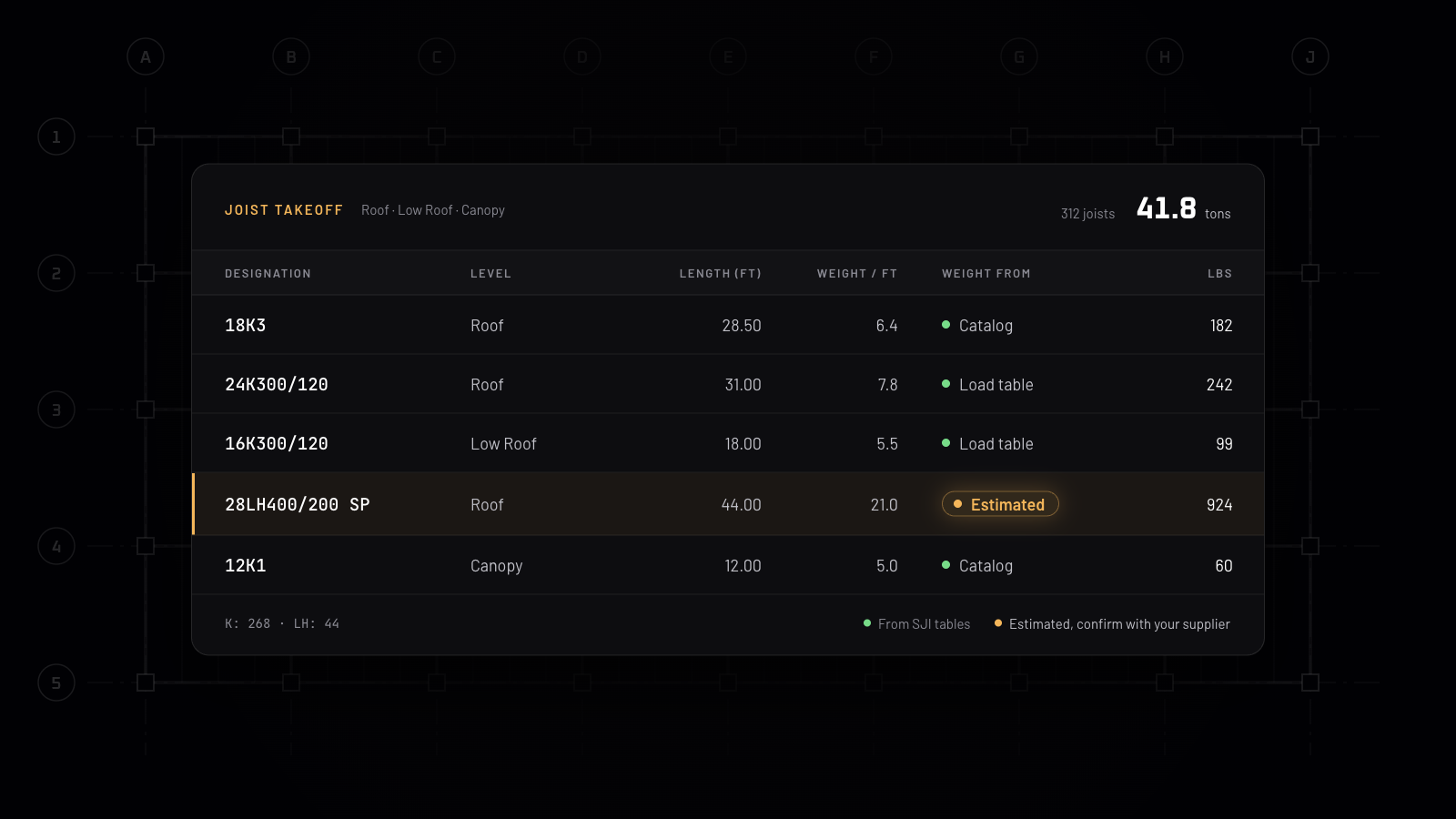
The weight column is where it saves the most lookups. Every joist shows its weight per foot and where that number came from. Catalog means a standard designation. Load table means a load/load callout, looked up using the span. Estimated means it wasn't in a standard table, which tells you exactly which joists to check with the supplier.
Joists also carry their own price per ton, separate from the structural steel, so the joist rate doesn't skew the rest of the bid. They show in the 3D model sitting on their girders, work in metric, and export to CSV, Tekla PowerFab and IFC.
You still check every one. The software does the reading and the lookups, and the estimator signs off.
FAQs
What is the difference between a bar joist and a joist girder?
A bar joist is a lightweight open web steel joist that carries the floor or roof deck. A joist girder is a heavier open web member that carries the bar joists at evenly spaced panel points and frames into the columns. On a takeoff, count them separately. A joist girder priced as a beam usually ends up at the wrong rate and weight.
How do you read a steel joist designation?
Read it as depth, series, then section number. 24K8 is a K-series joist, 24 inches deep, chord section 8. Load/load designations replace the section number with loads: 24K550/220 means 550 plf total load and 220 plf live load. LH and DLH follow the same pattern for longer spans.
What does 48G8N8.8K mean on a joist girder?
It's a joist girder 48 inches deep, with 8 joist spaces, carrying 8.8 kips at each panel point. G marks a girder. The number before N is the count of joist spaces, and the number after N is the panel point load in kips. The supplier designs the final girder and its weight.
How much does a steel joist weigh per foot?
It depends on the series, the section or load, and the span. Standard designations have an approximate weight per foot in the SJI load tables, not counting accessories such as bridging. Load/load joists need the span to look up. Treat any joist weight as an estimate until the supplier designs the job.
What is an OWSJ in Canada?
OWSJ stands for open web steel joist, the Canadian term for a bar joist. In Canada, the joist supplier designs the joists under CSA S16. The building designer specifies the loads, so a Canadian set may show loads rather than an SJI-style designation. The weight then comes from the loads and spans or from the supplier.
Can takeoff software read joist designations?
Yes. Ferra reads K, LH, DLH, CJ and joist girder callouts off the framing plan. For load/load callouts, it looks up the weight per foot from the SJI load tables using the span. It also marks any weight it had to estimate. Joists are priced at their own rate, and the estimator reviews every one.
If you've got a joist roof on your desk, send us the set. We'll take it off with you in a demo.