
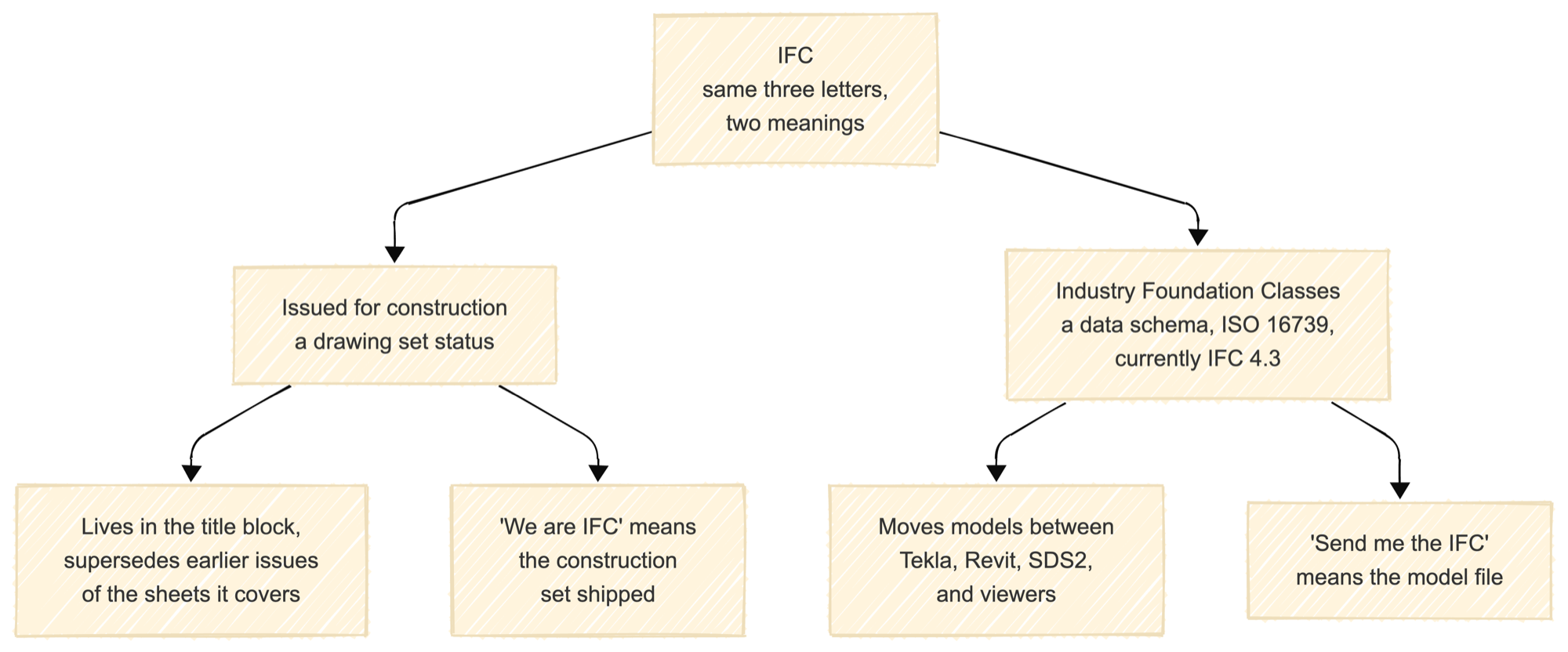
IFC drawings are the set issued for construction, the design team's release that the project can be built from, superseding earlier issues of the sheets it covers. The same letters also name Industry Foundation Classes, the open BIM file format, so context decides which is meant. Steel is often bid earlier, on 30 or 60 percent or issued-for-bid sets.
Key facts
- IFC on a drawing means issued for construction: the design team has released it to build from. It supersedes the earlier issues of the sheets it covers, and the status lands per sheet, not always per package.
- The same three letters also name a file format, Industry Foundation Classes, the open BIM exchange format. Context tells you which one you are reading.
- Percent milestones like 30, 60, and 90 are an owner convention layered on the design phases. The IFC issue is sometimes the bid set stamped IFC, and sometimes a conformed set that folds the addenda in.
- Steel packages are frequently bid before IFC, on a 30 or 60 percent set or one stamped IFB, issued for bid, which is where re-estimate pain comes from.
- IFC does not mean final. Revisions keep arriving after IFC, as bulletins and ASIs, and each one supersedes the sheet it re-issues.
Where IFC sits in the drawing lifecycle
A project's drawings mature in stages. Early sets exist to communicate design intent and rough scope. Somewhere around 60 percent the structure is mostly resolved, and the IFC issue is the design team's statement that the set can be built from. How it arrives varies: on some jobs the bid set is simply re-stamped IFC, on others a conformed set folds the addenda in first, and disciplines can go IFC at different times, so the status is really per sheet. The title block says issued for construction, and contractually this is the set your shop drawings will be checked against.
For a fabricator the IFC set is the reference point for everything that follows. Material gets ordered against it, detailing starts from it, and every later bulletin is measured as a change against it.
IFC is one stamp in a family you will see in title blocks:
| Stamp | Means | What a fabricator does with it |
|---|---|---|
| IFR | Issued for review | Read it, comment, do not price it as scope |
| IFA | Issued for approval | Owner or client sign-off on the design deliverable; shop-drawing approval is its own system under AISC 303 |
| IFB | Issued for bid | The set most steel bids are actually priced on |
| IFC | Issued for construction | Build from it; order material against it |
| IFT | Issued for tender | The same as IFB in UK and Commonwealth usage |
Is IFC a drawing set or a file format?
Both, and the collision is permanent. Industry Foundation Classes is an open data schema for built assets, published as ISO 16739 and currently at IFC 4.3, whose .ifc files move models between Tekla, Revit, SDS2, and viewers. A detailer saying "send me the IFC" wants the model file. A project manager saying "we are IFC" means the construction issue shipped. Both usages are correct, both are everywhere in steel, and mishearing one for the other in a kickoff call is a rite of passage.
Why does bidding before IFC cost money?
A bid priced on a 60 percent set is a bid on a design that is still moving. The estimators we talk to describe winning work on early sets and then receiving the IFC issue as an effectively new design, which means a re-estimate from scratch and a fight over what counts as a change. The protection is procedural: qualify the bid to the set and date you priced, list what was assumed, and compare the IFC issue against your takeoff the day it lands.
Example
One sheet's revision history tells the whole story. S2.1 shows rev 0 "Issued for bid" on March 3, rev 1 "Addendum 2" on March 18, rev 2 "Issued for construction" on May 6, and rev 3 "Bulletin 4" on July 22. The steel was bid against rev 1. The shop drawings get checked against rev 2. The change order argument is about rev 3. Three different conversations, one sheet, and the takeoff has to know which revision each of its numbers came from.
How Ferra handles this
Ferra takes off whichever set exists today and compares it against the next issue, including the jump from a 60 percent set to IFC, so the re-estimate becomes a review of listed changes. Both meanings of IFC apply: it also exports the takeoff as an IFC model file for Tekla, Revit, or SDS2, previewed in place before the download. See Revision Control and 3D Model.
Sources
- buildingSMART International, the body behind Industry Foundation Classes, published as ISO 16739 and currently at IFC 4.3.
- AISC 303, Code of Standard Practice for Steel Buildings and Bridges, on released-for-construction documents as the basis for fabrication.