
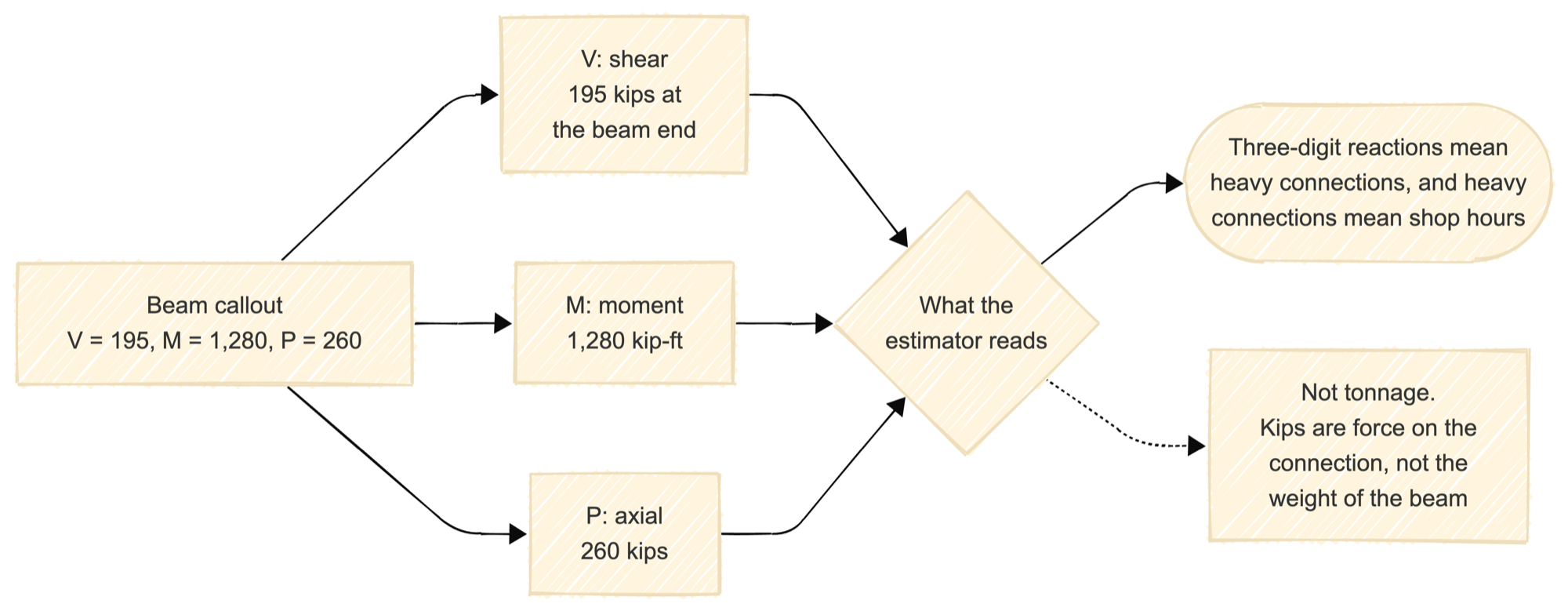
A kip is 1,000 pounds of force, a contraction of kilopound, equal to 4.448 kilonewtons. Structural drawings state beam end reactions, axial loads, and moments in kips and kip-feet. Estimators read them as a pricing signal: big reactions mean heavy connections, and heavy connections mean shop hours.
Key facts
- One kip is exactly 1,000 pounds of force. The name is a contraction of kilopound.
- Conversions: 1 kip = 1,000 pounds of force = 4.448 kilonewtons. Going the other way, 1 kN is about 0.2248 kips.
- Moments are given in kip-feet (kip-ft) and sometimes kip-inches. A 1,280 kip-ft moment is 1,280,000 pound-feet.
- On structural drawings, kips are how end reactions and axial loads are stated: the shear, moment, and axial forces at each beam end and column.
- Some shops convert reactions when pricing connections from a schedule, but the estimator's real use of kips is the signal: bigger reactions mean bigger connections, and bigger connections mean shop hours.
Where an estimator meets kips
Beam-end design forces on framing plans and schedules: a callout like V = 195, M = 1,280, P = 260 is telling the connection designer this beam end must carry 195 kips of shear, a 1,280 kip-ft moment, and 260 kips of axial force. Column schedules sometimes carry axial loads in kips per tier. General notes state design criteria in kips, ksf, and the sibling unit ksi, kips per square inch, which is how steel grade appears: Fy = 50 ksi.
None of this asks the estimator to do engineering. It asks the estimator to notice. A framing plan full of three-digit shear values is a job whose connections will be heavy, and a bid that priced typical shear tabs against it is wrong before the math starts.
How many pounds is a kip?
Exactly 1,000. The worked line an estimator actually runs: a 150 kip reaction is 150,000 pounds of force, which is 75 short tons of force on that connection, and still zero tons on the takeoff, because the takeoff weighs steel and a reaction weighs nothing.
What is the difference between kips and ksi?
A kip is a force. Ksi is a stress, kips per square inch, force spread over area. Reactions and axial loads come in kips; material strength comes in ksi, which is why the callout says V = 195 and the general notes say Fy = 50 ksi about the same beam.
Quick conversions
| From | To | Multiply by |
|---|---|---|
| kips | pounds | 1,000 |
| kips | kilonewtons | 4.448 |
| kilonewtons | kips | 0.2248 |
| kip-ft | pound-feet | 1,000 |
| kips | short tons of force | 0.5 |
The last row is the estimator's trap. A kip is half a short ton of force, but takeoff tonnage is mass of steel, not force on a connection. The 195 in a shear callout has nothing to do with how much the beam weighs.
How Ferra handles this
Ferra reads the end reactions, the V, M, and P values, off each detected beam along with its size and connection notes, so the estimate can see where the heavy connections are without anyone re-keying kips from the plans. The pricing side of that is covered in what drives shop hours per ton in structural steel.
Sources
- Usage: AISC Shapes Database v16.0 and the Steel Construction Manual it accompanies, where member capacities are tabulated in kips. The unit itself is US customary practice, defined below.
- Unit definitions: 1 kip = 1,000 lbf by definition; SI conversion via 1 lbf = 4.44822 N.