
An addendum changes the bid documents before the contract is awarded, and its cost is absorbed into the bid. A change order modifies the signed contract afterward, priced and negotiated on its own. Bulletins and ASIs deliver the drawing changes in between; the change order is where their cost and schedule impact gets agreed.
Key facts
- The dividing line is award. An addendum changes the bid documents before the contract exists. A change order modifies the contract after it is signed.
- Addendum cost lives inside your bid number. Change order cost is priced on its own, defended on its own, and paid on its own.
- Competitive pressure works in opposite directions. Addenda get absorbed to stay low. Change order pricing happens after bid-day competition has left the room, though it is still negotiated, often against your own bid's unit prices.
- In between sit bulletins, ASIs, and construction change directives, which issue the drawing changes that change orders later price.
- Steel change orders are rarely about the changed member. The cost is in what the change touches: connections, studs, cambers, and pieces already fabricated.
The timeline
| Addendum | Change order | |
|---|---|---|
| When | During bidding, before award | After the contract is signed |
| Issued by | The owner or architect, to bidders of record, numbered | Owner, contractor, and architect on the prime contract; a fabricator signs a subcontract change order with the GC |
| What it changes | The documents you are pricing | The contract sum and schedule |
| Where the cost goes | Inside the bid, absorbed or carried | Priced standalone, with backup |
| Your leverage | None, every bidder gets it | Real, but so is the scrutiny |
Why the distinction matters to a fabricator
An addendum that grows the scope and gets missed leaves the quote wrong, and nobody rejects a wrong quote. They award it, and the shop eats the difference. A change order that grows the scope is revenue, but only if the estimate can show what actually changed. The GC's first question is always why it costs so much, and the answer has to trace member by member.
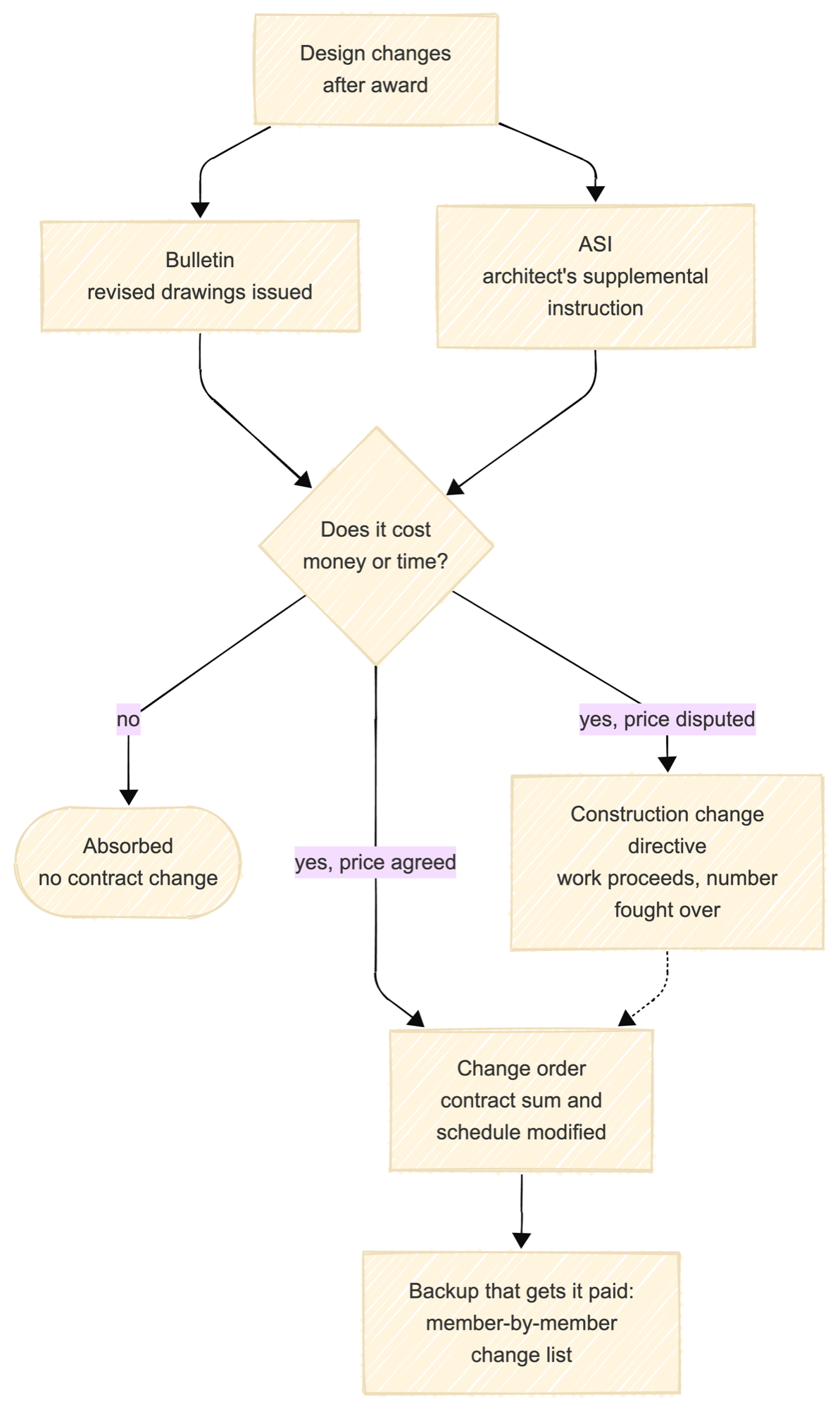
That trace is the hard part. A revision comparison that lists every changed member, with tonnage and connection deltas, is the backup that gets a change order paid.
What about bulletins and ASIs?
They are the delivery mechanisms. A bulletin issues revised drawings after award. An ASI, an Architect's Supplemental Instruction, is by the book a minor change with no cost or time impact. In practice ASIs arrive carrying drawings that do change cost, and when one does, it gets priced like any other change: it becomes a change order. If the parties disagree on price, a construction change directive can force the work forward while the number is fought over. The estimator's job is the same in every case: find what changed, price what it touches.
Example
Bulletin 3 upsizes one beam, a W14x22 to a W14x30 at grid D. The member itself is a few hundred pounds of steel. The change order is not: both end connections get redesigned for the heavier reactions, twelve studs are added, and the W14x22 was cut and coped last week, so it is now scrap plus a remake slot in the shop schedule. The backup that gets this paid lists all of it, line by line, against the bulletin. The backup that does not is a lump sum with the beam's weight in it.
How Ferra handles this
Ferra compares any two drawing sets, before or after award, and returns the changed members with their tonnage, stud, and camber deltas, which is the member-by-member backup a change order needs. The margin side of this is covered in why structural steel fabricators lose margin on change orders.
Sources
- AIA A701, Instructions to Bidders, which defines addenda as instruments issued prior to execution of the contract.
- AIA G701, Change Order and G701S, the subcontractor change order, the form a fabricator actually signs with the GC.
- AIA G714, Construction Change Directive, the instrument that directs work forward before price is agreed.
- AIA G710, Architect's Supplemental Instructions, the minor-change instrument that is not supposed to move contract sum or time.